Cobra Effect · Incentives and systems
The winner’s curse
Win an auction for something uncertain and you probably overpaid.
7 cards, read aloud in 2:53, with a test and sources.
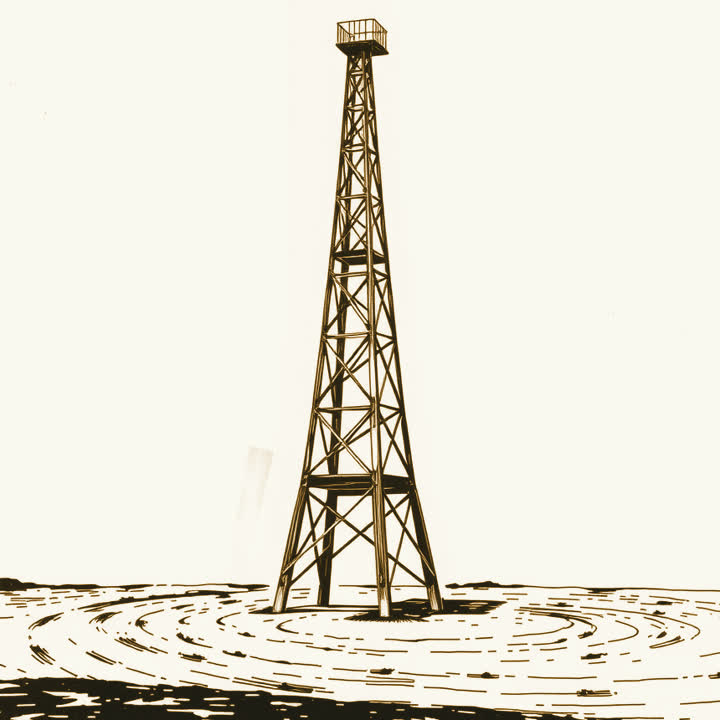
Gulf of Mexico, the 1960s. Oil companies keep winning leases and coming up short.
The government auctions the right to drill a patch of seabed. Nobody knows how much oil is down there. Every company estimates, then bids. The highest bid wins. And year after year, the winners earn less than they expected. Sometimes nothing.
In 1971, three engineers at Atlantic Richfield work out why.
Capen, Clapp and Campbell publish a paper called Competitive Bidding in High-Risk Situations. Their argument is simple and unwelcome. The oil under a tract is worth the same to everyone. The estimates are all over the place. So who wins the auction? The company whose guess was highest.
The highest bidder is the one who overestimated the most.
Ten companies guess. The guesses scatter around the truth, some high, some low. The average guess might be about right. But the average doesn’t win. The top guess wins. Winning is evidence that you were the most wrong.
That is the winner’s curse.
When many people bid for something with one true value that none of them knows, the winning bid tends to be too high. Not because bidders are fools. Because an auction selects for the biggest error. Richard Thaler put it on the cover of a book in 1992.
The jar of coins proves it in any classroom.
Fill a jar with coins and auction it to a room of students. The typical bid comes in below what the jar holds. The winning bid comes in well above it. The winner pays for the jar and loses money on the deal. Economists have run it for decades, and Thaler described the results in the 1980s.
It bites wherever the prize has one value and many bidders.
The company that wins a bidding war for a takeover target. The club that signs the star player every other club also wanted. The house you bought because you outbid eleven other families. Each time, ask what it means that everyone else stopped.
The fix is to bid as if you have already won.
Before you bid, ask: if my number turns out to be the highest of all, what does that tell me about my estimate? Usually that it is too high. So shade it down, and shade more when there are more bidders. The engineers’ advice to the oil companies was the same. Bid less, win less often, and make money on what you win.
Sources
- Winner’s curse, Wikipedia. The idea, the 1971 oil lease paper by Capen, Clapp and Campbell that named it, and the experiments that followed. Search for Competitive Bidding in High-Risk Situations to find the original.
- The Winner’s Curse: Paradoxes and Anomalies of Economic Life, Richard Thaler, 1992. Thaler’s Anomalies columns rewritten for a general reader, with the jar of coins and the oil leases in the title chapter. This page is Thaler’s biography and lists the book.
- Common value auction, Wikipedia. The auction theory underneath: what happens when the prize is worth the same to everyone but nobody knows what that is, and how careful bidders shade their bids.
Nearby ideas
- Regression to the mean. Extreme results drift back towards normal, whatever you do.
- Overconfidence. Why we feel more certain than our knowledge allows.
- Survivorship bias. The failures you never see can reverse the lesson you draw.
- Externalities. Why things get overdone when someone else pays part of the cost.
- Schelling’s segregation model. Mild preferences can add up to a sharply divided world.
- The Red Queen effect. When everyone improves at once, running hard only keeps you in place.
- The Cobra effect. Why paying for a result can breed more of the problem.
- Goodhart’s law. A measure turned into a target stops telling you the truth.