Cobra Effect · Incentives and systems
Externalities
Why things get overdone when someone else pays part of the cost.
6 cards, read aloud in 2:28, with a test and sources.
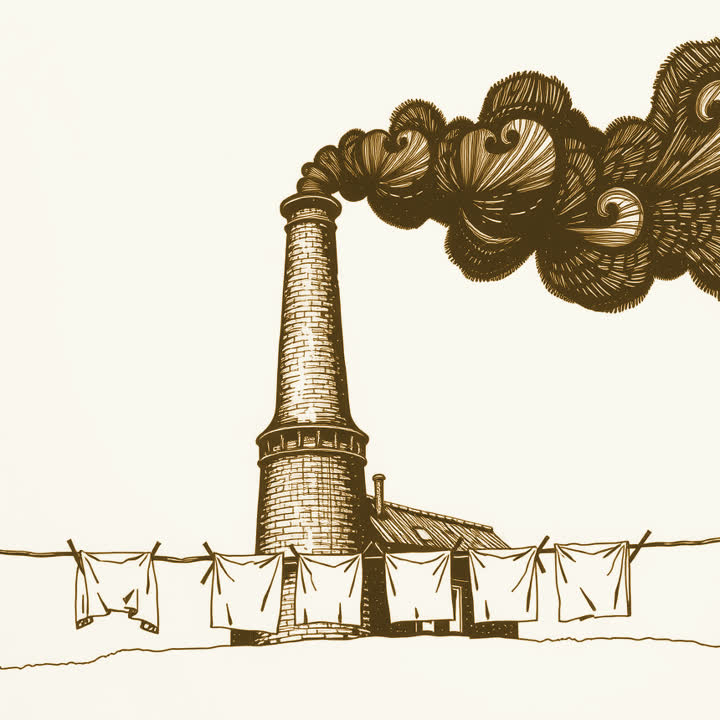
A factory chimney and a laundry share a street.
The factory burns coal and makes cheap goods. The laundry hangs clean sheets out to dry, and takes them in grey. The factory pays for its coal, its workers and its bricks. It does not pay for the sheets.
Arthur Pigou saw the missing bill in 1920.
In The Economics of Welfare, the Cambridge economist described costs that a business creates but never pays. Smoke that dirties a city. Sparks from a railway engine that set fire to a wood. He called the gap between private cost and social cost a problem for the whole economy, not a nuisance for the neighbours.
That is an externality. A cost paid by someone who was not at the table.
The factory and its customers agree a price. The laundry, the neighbours and the people breathing the smoke were never asked. So the price is too low, and too much gets made. Externalities can be good too. A beekeeper’s bees pollinate the orchard next door for free. Then too little gets made.
Pigou’s answer was a tax the size of the damage.
Make the factory pay for the sheets, and it will make exactly as much as is worth making. Economists still call it a Pigouvian tax. Ronald Coase added in 1960 that if the two sides can bargain cheaply, they can settle it themselves. Usually they can’t. The people breathing the smoke are thousands, and were never in the room.
The congestion charge is the idea with a number plate.
Every car that enters a crowded city centre slows every other car. The driver pays for petrol, not for the minutes taken from everyone else. Singapore started charging for the right to drive in from 1975. London followed in 2003, at 5 pounds a day. Put a price on the cost, and people who don’t need to drive, don’t.
The question to ask about any price.
Who pays for this that isn’t here? If the answer is somebody, the price is lying, and you will get more of the thing than anyone wants. Find the missing bill. Then find a way to send it.
Sources
- Externality, Wikipedia. The idea from Marshall through Pigou to Coase, with the standard examples, positive and negative, and the argument between taxing and bargaining.
- The Economics of Welfare, Arthur Cecil Pigou, 1920. The book that set out the gap between private and social cost and proposed the corrective tax. This page is Pigou’s biography, which covers the book and where it led. The full text is free online.
- Pigouvian tax, Wikipedia. The fix in practice: carbon prices, congestion charges, sugar taxes, and the objections to each.
Nearby ideas
- The tragedy of the commons. Why shared things get used up, and how communities stop it.
- Second order effects. Every fix has consequences, and those have consequences too.
- Moral hazard. Shield people from a risk and they take more of it.
- Schelling’s segregation model. Mild preferences can add up to a sharply divided world.
- The Red Queen effect. When everyone improves at once, running hard only keeps you in place.
- The Cobra effect. Why paying for a result can breed more of the problem.
- Goodhart’s law. A measure turned into a target stops telling you the truth.
- The Jevons paradox. Why making something efficient can make us use more of it.