Cobra Effect · Incentives and systems
Schelling’s segregation model
Mild preferences can add up to a sharply divided world.
6 cards, read aloud in 2:10, with a test and sources.
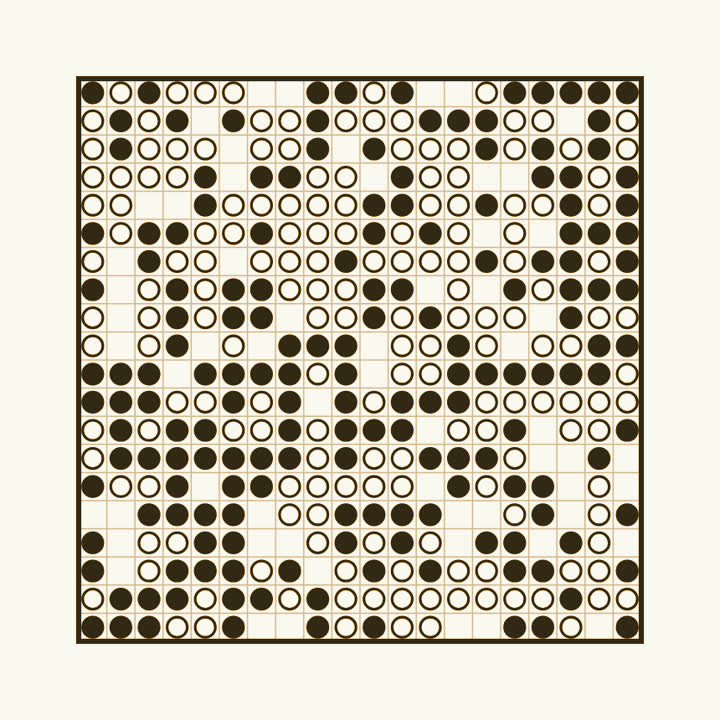
A man sits down at a chessboard with a handful of coins.
Thomas Schelling, 1971. An economist with a board and two kinds of coin. He scatters them across the squares at random and leaves a few squares empty. Then he gives every coin one small rule to live by.
The rule is mild. Nobody on this board is a bigot.
Each coin wants a few of its neighbours to be like it. Not most of them. It just does not want to be almost alone. An unhappy coin moves to the nearest square where it would be content. That is the whole model.
Move the unhappy coins, one at a time, and watch.
Every move leaves a gap behind and crowds somewhere else. So a coin that was content a moment ago is now unhappy, and it moves too. After a few rounds the board is not mixed any more. It has sorted itself into solid patches, with clean lines between them.
Nobody wanted that. Everybody built it.
Not one coin asked for a neighbourhood of its own kind. Every coin would have been perfectly happy on a mixed street. The pattern that comes out is far more extreme than any preference that went in.
What a crowd produces is not the average of what it wants.
Small preferences, acted on again and again, compound into an outcome nobody chose. Schelling published this in 1971 and spent a career on the gap between what people want and what they get. He shared the Nobel prize in economics in 2005.
So stop reading the outcome back as the motive.
A divided map is not proof that everybody wanted division. Before you blame the people, take their small rule and run it forward a few rounds. And if you want a mixed result, remember that a mild preference is not mild enough to ignore.
Sources
- Schelling’s model of segregation, Wikipedia. The 1971 paper Dynamic Models of Segregation, the checkerboard with coins, and what later researchers found when they varied the rules.
- Micromotives and Macrobehavior, Thomas Schelling, 1978. His own book on the gap between what individuals want and what crowds produce. The segregation board is one chapter of many.
- Parable of the Polygons, Vi Hart and Nicky Case. A playable version of the model. Drag the shapes, set how picky they are, and watch a mixed board sort itself in front of you.
Nearby ideas
- Feedback loops. Why some systems spiral out of control and others settle down.
- Path dependence. Why early choices stay locked in long after better ones appear.
- Second order effects. Every fix has consequences, and those have consequences too.
- The Red Queen effect. When everyone improves at once, running hard only keeps you in place.
- The Cobra effect. Why paying for a result can breed more of the problem.
- Goodhart’s law. A measure turned into a target stops telling you the truth.
- The tragedy of the commons. Why shared things get used up, and how communities stop it.
- Moral hazard. Shield people from a risk and they take more of it.