Cobra Effect · Incentives and systems
The Red Queen effect
When everyone improves at once, running hard only keeps you in place.
6 cards, read aloud in 2:24, with a test and sources.
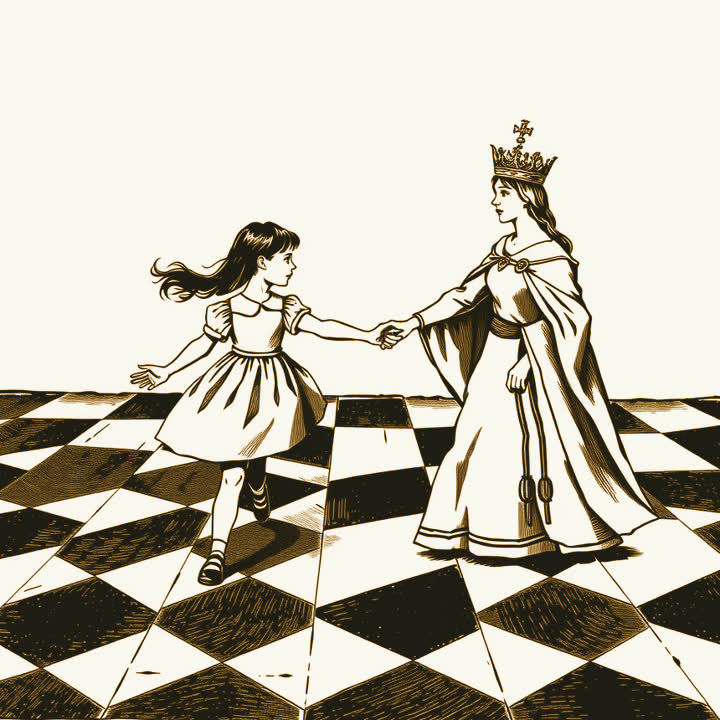
Alice runs as hard as she can and stays exactly where she is.
Lewis Carroll, 1871. Alice and the Red Queen tear across a chessboard country, and the scenery keeps pace with them. Here, says the Queen, it takes all the running you can do to keep in the same place.
1973. A biologist notices that extinction never slows down.
Leigh Van Valen worked through fossil records across many groups of animals. He expected old, well established species to be safer than young ones. They were not. The chance of a group dying out stayed about the same however long it had already survived. Experience was buying nothing.
His explanation. Everything you compete with is improving too.
A faster predator makes a faster prey animal necessary. A faster prey animal makes a faster predator necessary. Both sides keep adapting and neither gets ahead. Van Valen named it after the Red Queen and published it in 1973, in a journal he had founded himself.
Parasites are the clearest case of it.
A parasite that cracks a host’s defence spreads fast. A host with a new defence outbreeds the rest. Neither side wins and both keep changing. One leading explanation for why so many species bother with sex is exactly this, since a reshuffled set of defences is harder to crack.
The same treadmill runs through business and through your week.
A shop that improves its service gains nothing, if every shop improves. The running is not wasted. Stop and you fall behind within a season. Effort that only keeps you level still has to be spent, and it still costs what it costs.
So ask what your running is actually buying.
Some effort buys ground. Some only stops you losing it. Both can be worth doing, and they are not the same thing. Write down which of this year’s work is a real gain, and which is rent you pay to stay where you are. Then at least you know what you are paying for.
Sources
- Red Queen hypothesis, Wikipedia. Van Valen’s 1973 paper A New Evolutionary Law, the constant extinction rate he found, and the host and parasite work that followed it.
- The Red Queen, Matt Ridley, 1993. The popular book that carried the idea beyond biology, mostly through the argument about why sexual reproduction exists at all.
- Evolutionary arms race, Wikipedia. The mechanism in detail. Predator and prey, parasite and host, and why an advance on one side is answered rather than banked.
Nearby ideas
- The race to the bottom. When rivals keep undercutting each other, everybody loses.
- Feedback loops. Why some systems spiral out of control and others settle down.
- Antifragility. Some things get stronger from knocks, and fail without them.
- The Cobra effect. Why paying for a result can breed more of the problem.
- Goodhart’s law. A measure turned into a target stops telling you the truth.
- Second order effects. Every fix has consequences, and those have consequences too.
- The tragedy of the commons. Why shared things get used up, and how communities stop it.
- Moral hazard. Shield people from a risk and they take more of it.