Cobra Effect · Heat and energy
No engine can be perfect
Why no engine can turn all its heat into work, and what sets the ceiling.
7 cards, read aloud in 3:34, with a test and sources.
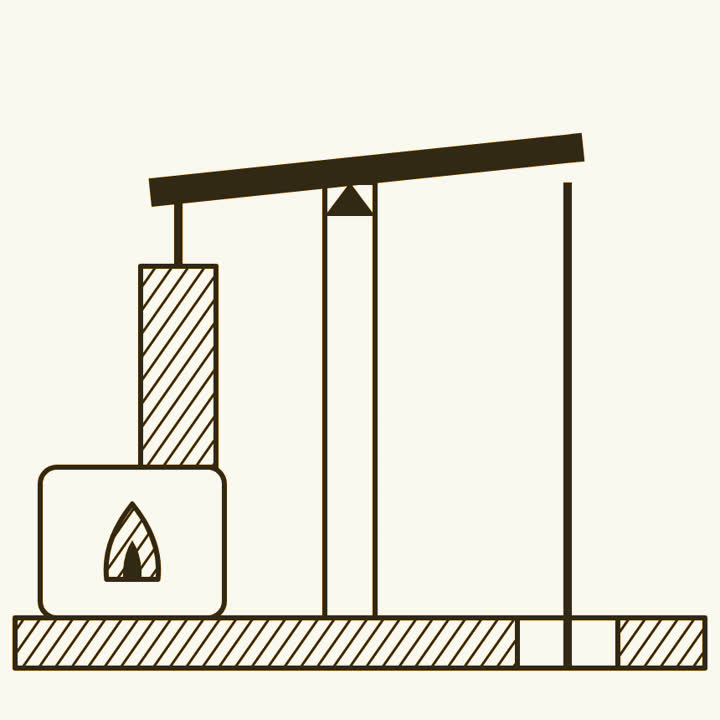
The first steam engines wasted almost all of their fuel.
Thomas Newcomen’s engines, from 1712 onwards, pumped water out of mines. They turned only about one per cent of the heat in their coal into useful work. In 1765 James Watt had the idea of cooling the steam in a separate chamber, so the cylinder could stay hot. His engines used about three quarters less fuel for the same work.
Carnot asked how good an engine could ever get.
He imagined a perfect engine, with no friction and no leaks, running on heat flowing from a hot place to a cold one. Even that engine cannot turn all of the heat into work. Some of it must always pass on into the cold side. How much it can use depends only on the two temperatures. The wider the gap between them, the larger the share that can become work.
The limit is a simple sum, once temperatures are counted up from absolute zero.
Divide the cold temperature by the hot one, and take the answer away from one. A power station making steam at about 560 degrees Celsius and cooling it to about 30 could, in theory, turn nearly two thirds of its heat into work. Real stations built that way manage around 40 per cent, because friction and leaks take more. No amount of cleverness gets past the sum.
A car engine turns most of its fuel into heat.
A typical petrol engine turns around a quarter to a third of the energy in its fuel into motion. Most of the rest leaves through the radiator and the exhaust. Part of that loss is set by Carnot’s sum. The rest is friction, and heat escaping where it does no work. That is why a car’s radiator is too hot to touch after a drive.
The best power stations get more than twice as much work from their fuel.
A combined cycle station burns gas in a turbine, much like a jet engine, and uses the hot exhaust to raise steam for a second turbine. Heat that one engine would throw away runs the next. In 2024 one such station, Keadby 2 in Lincolnshire, was measured turning just over 64 per cent of its fuel’s energy into electricity. Using a bigger drop in temperature, in two steps, gets closer to Carnot’s limit.
Electric motors are not heat engines, so the limit does not apply to them.
A motor turns electricity straight into motion, without first making heat. Large electric motors turn more than 90 per cent of the electricity they use into work. Carnot’s limit only bites where heat is what is being turned into work. But if the electricity came from burning fuel, a heat engine paid that price earlier, at the power station.
So when a machine promises more work from heat, ask about its two temperatures.
Better engines come from hotter hot sides, colder cold sides and fewer leaks. Turbine blades are cooled from inside and coated so that they can sit in gas hotter than their metal could normally survive. Any claim of an engine beating Carnot’s limit goes the way of perpetual motion. The temperatures set the ceiling. Engineering decides how close you get.
Sources
- Carnot’s theorem, Wikipedia. Why no engine working between two temperatures can beat the perfect one, and the sum that sets its limit.
- Watt steam engine, Wikipedia. Newcomen’s wasteful engine, Watt’s separate condenser of 1765, and how much fuel it saved.
- Most efficient combined cycle power plant, Guinness World Records. The record set at Keadby 2 in 2024, just over 64 per cent, where a gas turbine and a steam turbine share the heat.
Nearby ideas
- Heat only flows one way. Why heat only flows from hot to cold, and what entropy is really counting.
- Energy never disappears. Why energy only ever changes form, and how a brewer’s paddle wheel proved it.
- Moving heat is cheaper than making it. Why a heat pump delivers more heat than the electricity it uses.
- Heat is things jiggling. Why heat is really motion, and how jiggling pollen proved molecules are real.
- Maxwell’s demon. Why a sorting demon cannot beat the second law, and what forgetting costs.