Cobra Effect · Heat and energy
Heat only flows one way
Why heat only flows from hot to cold, and what entropy is really counting.
7 cards, read aloud in 3:34, with a test and sources.
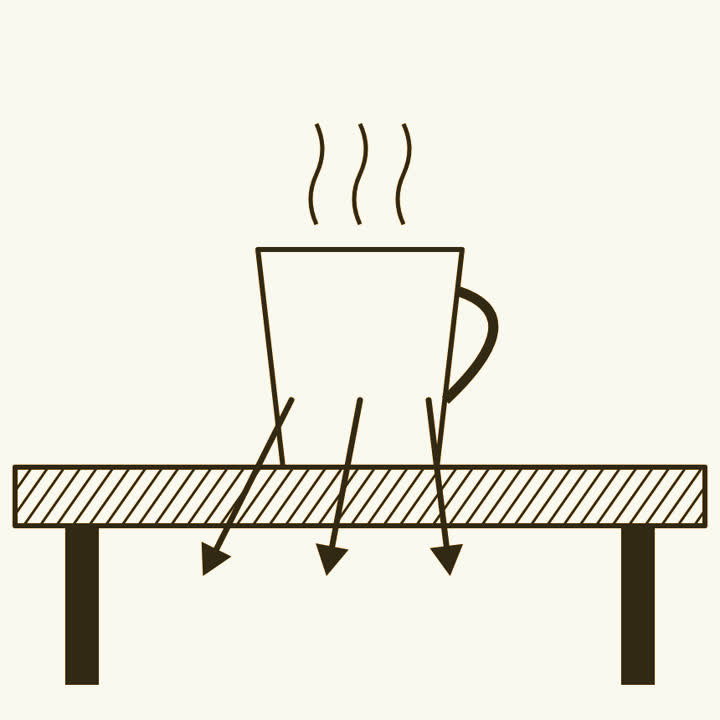
Put a hot drink on a cold table, and the drink cools. It never gets hotter.
The table warms a little and the drink cools, until the two meet in the middle. Nothing in the law of energy forbids the reverse. The drink could take heat from the table and boil, and the total energy would be the same. It never happens. Something beyond energy decides which way heat goes.
In 1824 a young French engineer asked what limits a steam engine.
Sadi Carnot published a short book, Reflections on the Motive Power of Fire. An engine, he saw, makes work only by letting heat fall from something hot to something cold, the way falling water turns a mill wheel. The bigger the drop in temperature, the more work it can give. Carnot died of cholera eight years later, aged 36, and the book was nearly forgotten.
In the 1850s Rudolf Clausius turned the idea into a law.
Heat does not pass by itself from a colder body to a hotter one. A fridge can push heat uphill, but only by spending energy to do it, and it warms your kitchen by more than it cools its box. William Thomson, later Lord Kelvin, reached the same law from engines at around the same time. It became the second law of thermodynamics.
In 1865 Clausius gave the one-way quantity a name. Entropy.
He built the word from the Greek for transformation, to sit beside energy. Energy stays the same. Entropy, in anything left to itself, never goes down. Hot and cold kept side by side is low entropy. The same heat spread evenly is high. Heat flows from hot to cold because that is the way entropy rises.
Ludwig Boltzmann showed what entropy is counting.
Imagine all the air in a box squeezed into one corner. There are very few ways to arrange the molecules like that. Spread through the whole box, there are unimaginably more. Molecules jiggling at random end up spread out simply because there are so many more ways to be spread out. Entropy counts the ways. His formula for it is carved on his grave in Vienna.
That is why a film of a breaking egg looks wrong played backwards.
The laws that move single molecules work just as well in either direction of time. But there are vastly more ways for an egg to be broken than whole, so a broken egg never puts itself back together. Arthur Eddington called this the arrow of time, in lectures he gave in 1927. Rising entropy is how you tell the future from the past. The air in a room could gather in one corner. The odds are so small it would not happen once in the life of the universe.
So when something tidies itself up, ask where the mess went.
Living things build order all the time, from seeds into trees. They are not breaking the law. They take in orderly energy from sunlight or food and give out heat, which spreads disorder around them. A fridge cools its inside and warms the kitchen by more. Order in one place is always paid for with more disorder somewhere else.
Sources
- Second law of thermodynamics, Wikipedia. Carnot, Clausius and Kelvin, the ways the law can be stated, and entropy from heat engines to living things.
- Arrow of time, Wikipedia. Eddington’s phrase from 1927, and why rising entropy is what tells the future from the past.
- The Nature of the Physical World, Arthur Eddington, 1928. The published Gifford lectures, including the chapter where the arrow of time gets its name. Free to borrow online.
Nearby ideas
- Heat is things jiggling. Why heat is really motion, and how jiggling pollen proved molecules are real.
- Energy never disappears. Why energy only ever changes form, and how a brewer’s paddle wheel proved it.
- Maxwell’s demon. Why a sorting demon cannot beat the second law, and what forgetting costs.
- No engine can be perfect. Why no engine can turn all its heat into work, and what sets the ceiling.
- Moving heat is cheaper than making it. Why a heat pump delivers more heat than the electricity it uses.