Cobra Effect · Heat and energy
Moving heat is cheaper than making it
Why a heat pump delivers more heat than the electricity it uses.
7 cards, read aloud in 3:47, with a test and sources.
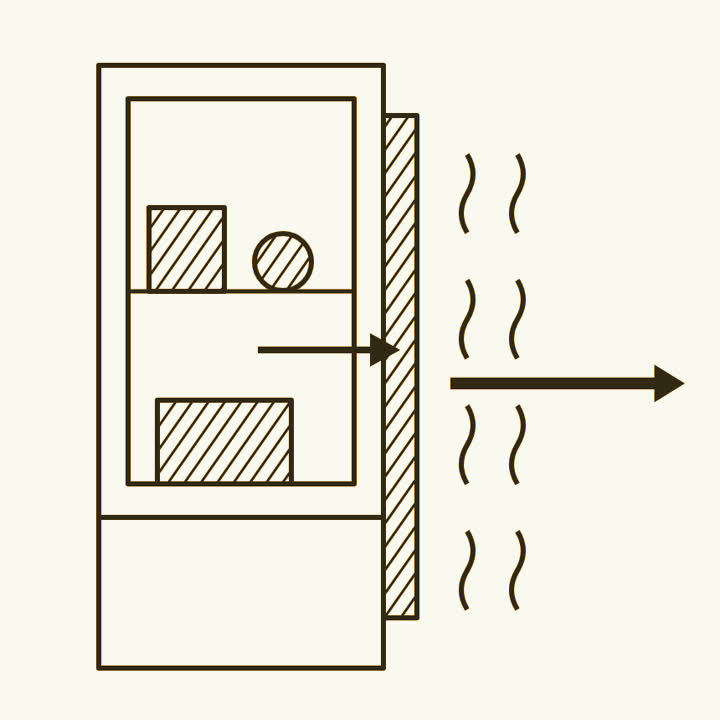
A fridge is pulling heat out of cold food and pushing it into a warm kitchen.
That is heat flowing uphill, and the second law allows it only if something pays. The fridge pays with electricity, running a pump that squeezes and releases a special fluid. Where the fluid is allowed to expand and boil, it goes cold and soaks up heat. Where it is squeezed, it gets hot and gives that heat away. Feel the back of a fridge. That warmth came out of your food.
Turn a fridge inside out, and it heats a house.
A heat pump does the same job facing the other way, taking heat from the air or ground outside and pushing it indoors. Even air below freezing still holds heat. Its molecules are still moving. In 1852 William Thomson, later Lord Kelvin, proposed exactly this, and called it a heat multiplier. In 1856 the Austrian mining engineer Peter von Rittinger built a working one, to dry out salt.
For each unit of electricity, a heat pump can deliver three or more units of heat.
An electric heater turns one unit of electricity into one unit of heat, and no more. A heat pump uses its electricity to move heat rather than make it, so it can deliver more heat than the energy it uses. Over a year, household heat pumps typically deliver three to four times as much heat as the electricity they use. No energy is created. The extra comes from outside, where it already was.
The colder it is outside, the harder the pump has to work.
Moving heat up a bigger temperature gap costs more, just as Carnot’s sum says. Around freezing, a typical air source heat pump delivers two to three units of heat for each unit of electricity. Models built for cold climates still deliver more heat than they use at minus 30 degrees. Ground source pumps draw on soil that stays much the same temperature all year, so they lose less in winter.
In 1951 a London concert hall was heated from the River Thames.
When the Royal Festival Hall opened for the Festival of Britain, a heat pump drew warmth from the river beside it. Its compressors were driven by Rolls-Royce Merlin engines, the kind that powered wartime fighter planes, adapted to run on gas. The river in winter was cold, but it held plenty of heat to move. The system gave trouble and did not last, but it showed that a building could be warmed from a cold river.
In Norway, a country of long cold winters, most homes now have one.
By recent counts there are about six heat pumps for every ten Norwegian households. Most of them are air source pumps, working through winters far colder than Britain’s. Cheap, clean electricity from hydropower helped make them worth fitting. The idea that heat pumps only work in mild climates has not survived Norway.
So when you want warmth, ask whether you can move it instead of making it.
Burning fuel or running a heater makes heat from something else, one for one at best. A heat pump borrows heat that is already around you, and pays only for the moving. The same second law that stops heat flowing uphill for free sets the price, and the price is low when the climb is short. Warmth is everywhere. The trick is carrying it indoors.
Sources
- Heat pump, Wikipedia. How a heat pump moves heat uphill, why it delivers more heat than the electricity it uses, and its history from Kelvin and Rittinger on.
- How heat pumps became a Nordic success story, Carbon Brief. Why Norway, Sweden and Finland took up heat pumps in such numbers despite their cold winters.
- Coming in from the cold: heat pump efficiency at low temperatures, Joule, 2023. A study of how air source heat pumps really perform in winter, down to well below freezing.
Nearby ideas
- Heat only flows one way. Why heat only flows from hot to cold, and what entropy is really counting.
- No engine can be perfect. Why no engine can turn all its heat into work, and what sets the ceiling.
- Heat is things jiggling. Why heat is really motion, and how jiggling pollen proved molecules are real.
- Energy never disappears. Why energy only ever changes form, and how a brewer’s paddle wheel proved it.
- Maxwell’s demon. Why a sorting demon cannot beat the second law, and what forgetting costs.