Cobra Effect · Heat and energy
Maxwell’s demon
Why a sorting demon cannot beat the second law, and what forgetting costs.
7 cards, read aloud in 3:38, with a test and sources.
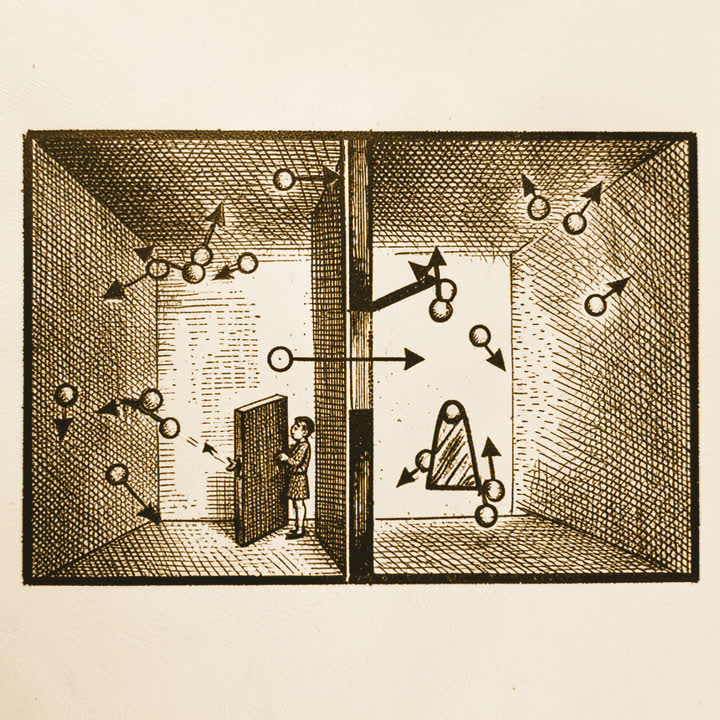
In 1867 James Clerk Maxwell imagined a tiny being that could make heat flow backwards.
He described it in a letter to his friend Peter Guthrie Tait. Take a box of gas split in two by a wall with a tiny door in it. The being watches the molecules, opens the door for fast ones heading one way and slow ones heading the other, and keeps it shut for the rest. Soon one side is hot and the other cold, and nobody has done any work.
That would break the second law.
Heat would be piling up on the side that was already warmer, and entropy would be going down. You could run an engine off the difference for ever, for nothing. Maxwell called his creature a finite being. William Thomson, later Lord Kelvin, gave it the name that stuck, in 1874. Maxwell’s demon. For about a century nobody could say for sure what was wrong with it.
In 1929 Leo Szilard shrank the puzzle to a single molecule.
One molecule in a box. Slide a wall into the middle and find out which side it is on. Knowing that, you can let it push the wall like a piston, and get a little work out of the heat around it. Knowing which side, it seemed, was worth energy. Szilard suspected the cost was hidden somewhere in the measuring.
In 1961 Rolf Landauer found where the cost really lies. Forgetting.
Landauer worked on computers at IBM. He showed that wiping a bit of memory, resetting it whatever it held before, must give off a minimum amount of heat. In 1982 Charles Bennett, also at IBM, showed that the demon could in principle measure without paying, but to keep going it must sooner or later clear its memory. The clearing makes at least as much entropy as the sorting removed. The second law survives.
In 2012 a team in Lyon measured the cost of forgetting one bit.
Antoine Bérut and colleagues held a glass bead two thousandths of a millimetre across in a trap made of laser light. The trap had two dips, making a one bit memory. Bead in the left dip meant nought, and in the right dip meant one. They wiped the bit again and again by pushing the bead into one dip, and worked out the heat given off. Done slowly, the heat came down to the amount Landauer predicted, and no lower.
The cost is tiny, and computers still pay far more than it.
At room temperature the minimum heat for wiping one bit is less than a billionth of a billionth of a joule. Today’s chips give off many thousands of times more than that for each operation, most of it for other reasons. As chips grow more efficient, Landauer’s limit is the floor they are heading towards. Information is not abstract. Keeping it and wiping it are physical acts, with a price in heat.
So when something seems to get order for free, ask what it had to forget.
Every sorting machine, living cell and computer keeps records of some kind. Records fill up, and clearing them costs heat. The demon was never beating the second law. Its bill was only delayed. Knowing can be cheap. Forgetting is what you pay for.
Sources
- Maxwell’s demon, Wikipedia. Maxwell’s letter of 1867, Kelvin’s name for the creature, Szilard’s single molecule, and the answer through Landauer and Bennett.
- Experimental verification of Landauer’s principle linking information and thermodynamics, Antoine Bérut and colleagues, Nature, 2012. The bead in the laser trap, the two dip memory, and the heat of wiping settling at Landauer’s limit.
- Landauer’s principle, Wikipedia. Why wiping a bit must give off heat, how small the cost is, and what it means for the future of computing.
Nearby ideas
- Heat only flows one way. Why heat only flows from hot to cold, and what entropy is really counting.
- Heat is things jiggling. Why heat is really motion, and how jiggling pollen proved molecules are real.
- No engine can be perfect. Why no engine can turn all its heat into work, and what sets the ceiling.
- Moving heat is cheaper than making it. Why a heat pump delivers more heat than the electricity it uses.
- Energy never disappears. Why energy only ever changes form, and how a brewer’s paddle wheel proved it.