Cobra Effect · Heat and energy
Heat is things jiggling
Why heat is really motion, and how jiggling pollen proved molecules are real.
7 cards, read aloud in 3:39, with a test and sources.
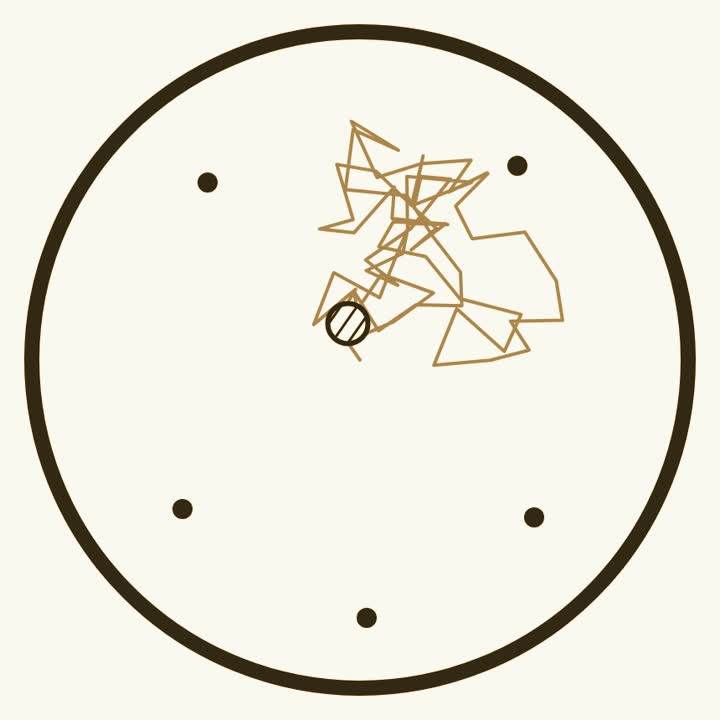
In 1827 a botanist watched specks from pollen dance in water, and could not make them stop.
Robert Brown was looking through a microscope at pollen grains soaked in water. Tiny particles from inside them jittered about, never settling. He suspected they might be alive, so he tried ground up rock, volcanic ash and meteorites, and even a fragment of the Sphinx. They all danced in just the same way.
In 1905 Albert Einstein said the specks were being kicked by molecules too small to see.
Water is made of molecules in constant motion, striking the speck from every side. At any instant a few more hit one side than the other, and the speck lurches. Einstein worked out how far a speck should wander. Four times the waiting brings only twice the distance. Many scientists still doubted molecules were real. Here was a way to check.
In 1908 Jean Perrin tracked the specks, and counted the molecules.
He made tiny beads of plant resin, all the same size, and marked where each one sat every thirty seconds. The zigzags matched Einstein’s sums. From them he worked out how many molecules make up eighteen grams of water, a number twenty four digits long. Even Wilhelm Ostwald, a famous chemist who had long doubted atoms, was won over. Perrin won the Nobel Prize in 1926.
Temperature is how fast the molecules are moving, on average.
The air around you is mostly nitrogen and oxygen, moving at about 500 metres a second at room temperature. Each molecule hits another billions of times a second. Warm the air and they move faster on average. Cool it and they slow. A thermometer is measuring the average jiggle of whatever touches it.
Drop ink into cold water and hot water, and the hot one clouds over first.
Faster molecules knock the ink about more, so it spreads sooner. Currents stirred up by the heat help it along. Yet a molecule moving at hundreds of metres a second takes an age to cross a glass on its own. It travels a tiny fraction of a millimetre before a collision sends it off another way, again and again.
Cool anything down and the jiggling slows, towards a floor it can never reach.
That floor is absolute zero, minus 273.15 degrees Celsius. William Thomson, later Lord Kelvin, proposed a temperature scale that starts from it in 1848. Laboratories have cooled atoms to within billionths of a degree of it. Even there the motion never stops entirely. Quantum mechanics leaves a last jiggle that no cooling can remove.
So when something feels hot, ask what is moving.
For a long time heat was thought to be an invisible fluid that poured from hot things into cold ones. In 1798 Count Rumford noticed that boring out cannon barrels made heat for as long as the boring went on, more than any stored fluid could hold. Touch a hot pan and its fast jiggling molecules knock into the slower ones in your skin, passing on their motion. Heat is not a substance. It is motion, handed on.
Sources
- Brownian motion, Wikipedia. Brown’s observations of 1827, Einstein’s explanation of 1905 and Perrin’s experiments, which settled whether molecules are real.
- Kinetic theory of gases, Wikipedia. How the motion of molecules explains temperature and pressure, with the speeds for ordinary air.
- Discontinuous structure of matter, Jean Perrin, Nobel lecture, 1926. Perrin’s own account of following the specks, checking Einstein’s sums and counting the molecules.
Nearby ideas
- The uncertainty principle. Why pinning down where a particle is spreads out where it is going.
- Energy never disappears. Why energy only ever changes form, and how a brewer’s paddle wheel proved it.
- Heat only flows one way. Why heat only flows from hot to cold, and what entropy is really counting.
- Maxwell’s demon. Why a sorting demon cannot beat the second law, and what forgetting costs.
- No engine can be perfect. Why no engine can turn all its heat into work, and what sets the ceiling.
- Moving heat is cheaper than making it. Why a heat pump delivers more heat than the electricity it uses.