Cobra Effect · Heat and energy
Energy never disappears
Why energy only ever changes form, and how a brewer’s paddle wheel proved it.
7 cards, read aloud in 3:55, with a test and sources.
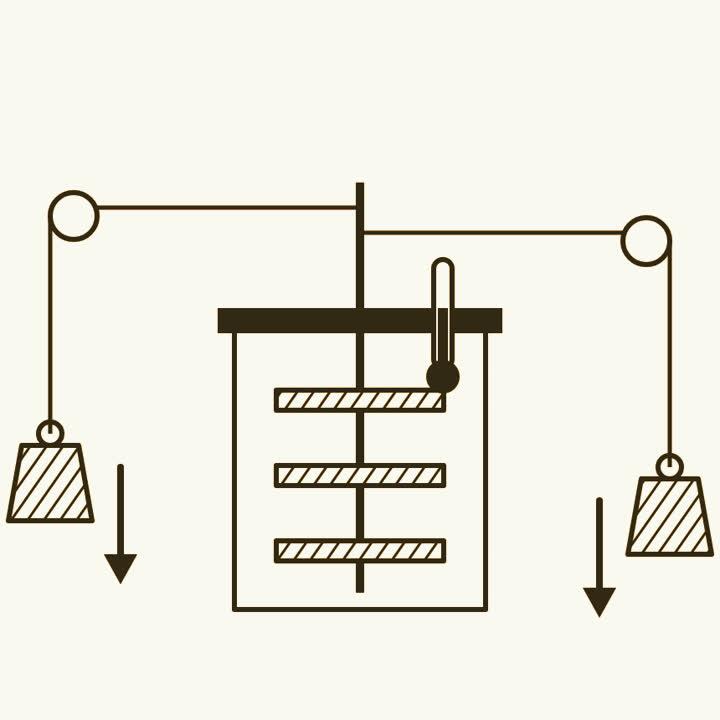
Stir water hard enough and it gets warmer. James Joule set out to measure by how much.
Joule was the son of a brewer in Salford, beside Manchester, and did much of his work in the brewery cellar. He hung weights on strings that turned a paddle wheel inside a closed can of water. As the weights fell, the paddles churned the water and its temperature crept up. Twenty or so drops of the weights warmed it by only a degree or two Fahrenheit, so his thermometers had to be superb.
In 1849 he announced the exchange rate between work and heat.
Lowering 772 pounds through one foot, he found, makes enough heat to warm a pound of water by one degree Fahrenheit. However the work was done, the same amount of work always gave the same amount of heat. Michael Faraday presented the result to the Royal Society in London. The unit of energy scientists use today is called the joule, after him.
A ship’s doctor had reached the same idea from the colour of blood.
In 1840 Julius Robert Mayer sailed to Java as a ship’s doctor. When he bled sick sailors there, as doctors then did, the blood from their veins came out bright red, almost like blood from an artery. In the heat, he reasoned, their bodies burned less food to keep warm, so less oxygen was used up. Food, heat and motion had to be forms of one thing. He published in 1842, and was largely ignored.
Energy changes form, and the total never changes.
In 1847 Hermann von Helmholtz set the idea out in full, across motion, heat, electricity and living things. Water falling through a turbine becomes electricity. Electricity in a kettle becomes heat. Food becomes the movement of your legs and the warmth of your body. Physicists call it the first law of thermodynamics. Energy is never made or destroyed, only moved and changed.
In 1930 physics came close to giving the rule up.
When some atoms decay they fire out an electron, and those electrons came out with a spread of energies, most of them short of what the sums required. Niels Bohr was prepared to accept that energy might only be conserved on average. Wolfgang Pauli refused. In a letter he guessed that an unseen particle was carrying off the missing energy. In 1956 Clyde Cowan and Frederick Reines detected those particles beside a nuclear reactor. The rule had held.
In 1918 Emmy Noether showed why the rule holds.
She proved that each smooth symmetry in the laws of nature comes with a quantity that is conserved. If the laws work the same today as they will tomorrow, energy is conserved. If they work the same here as they do over there, momentum is conserved. Einstein praised her penetrating mathematical thinking, and physicists still build new theories on the result.
So when energy seems to vanish, ask where it went.
A car braking to a stop turns its motion into heat in the brakes. A bouncing ball that comes to rest has warmed the floor, the air and itself by a tiny amount. Machines that claim to make energy from nothing have never worked, and the American patent office asks for a working model before it will consider one. Energy does not disappear. It spreads out, often where it is hardest to see.
Sources
- Conservation of energy, Wikipedia. The history from Mayer, Joule and Helmholtz to Noether, and what the law means in physics today.
- Heat, work and subtle fluids: a commentary on Joule (1850), Philosophical Transactions of the Royal Society A, 2015. How Joule ran the paddle wheel experiment in the brewery cellar, and what his 772 foot pounds meant.
- Noether’s theorem, Wikipedia. Why each smooth symmetry of nature comes with a conserved quantity, and how the sameness of time gives energy.
Nearby ideas
- Heat is things jiggling. Why heat is really motion, and how jiggling pollen proved molecules are real.
- Mass and energy are the same thing. Why mass and energy are the same thing, and why a gram holds so much.
- Heat only flows one way. Why heat only flows from hot to cold, and what entropy is really counting.
- Maxwell’s demon. Why a sorting demon cannot beat the second law, and what forgetting costs.
- No engine can be perfect. Why no engine can turn all its heat into work, and what sets the ceiling.
- Moving heat is cheaper than making it. Why a heat pump delivers more heat than the electricity it uses.