Cobra Effect · Science and philosophy
Galileo’s ship
Why you cannot feel steady motion from the inside.
7 cards, read aloud in 2:40, with a test and sources.
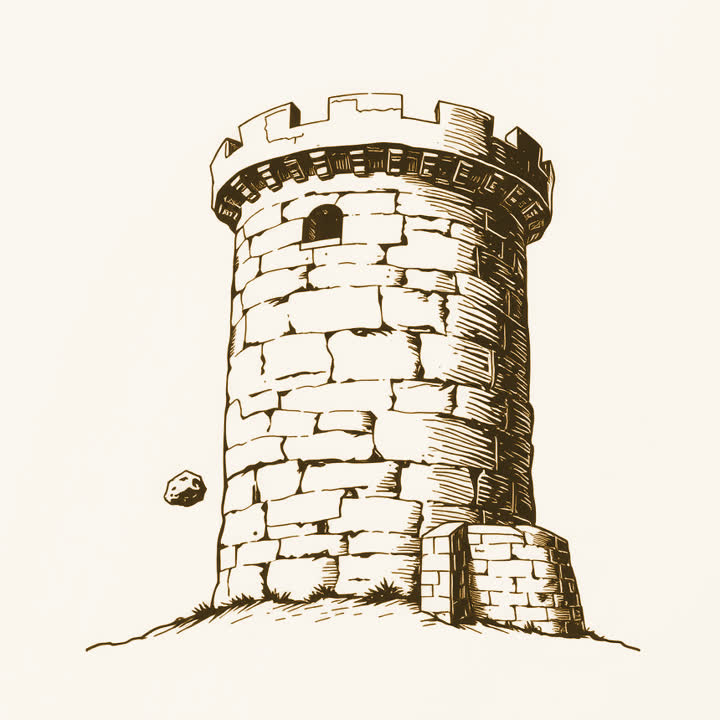
If the Earth is spinning, why doesn’t a dropped stone land behind you?
It was the strongest argument against the Earth moving, and it is a good one. Drop a stone from a tower. It lands at the foot of the tower. If the ground were racing east under it, the stone should land west of where you let go. It never does.
Florence, 1632. Galileo answers with a ship.
His book is called Dialogue Concerning the Two Chief World Systems. Three men argue for four days about whether the Earth moves. On the second day one of them says, go and shut yourself below decks on a large ship.
Take some flies, some butterflies, a bowl of fish and a dripping bottle.
Galileo lists them. Watch how the flies move. Watch the fish swim. Watch the drops fall into the vessel below. Now have the ship sail as fast as you like, so long as it sails smoothly. Look again.
Nothing has changed. Not one drop, not one fly.
The drops still fall straight into the vessel below. The flies do not pile up against the back wall. You can jump as far towards the stern as towards the bow. Nothing you do inside that cabin tells you whether the ship is moving.
That is the relativity of motion, and it is nearly 400 years old.
Steady motion is not something you can feel. It is only something you can measure against something else. There is no experiment that tells you, from the inside, that you are moving. You and the stone and the tower are all carried east together, so the stone lands at your feet.
The exception is the moment the ship stops being smooth.
Hit a rock and everyone in the cabin falls forward. A change in motion you can feel. Steady motion you cannot. The gap between those two is the whole idea.
The Church banned the book. The physics outlived the ban.
Galileo was tried the next year and spent the rest of his life under house arrest. Newton kept the rule. So did Einstein, who added that light moves at the same speed for everyone. So when something feels obviously still, ask what you are measuring it against. Every answer you have is from inside the cabin.
Sources
- Dialogue Concerning the Two Chief World Systems, Galileo Galilei, 1632. The book that got him tried. The ship and its cabin of flies, fish and falling drops arrive on the second day, as an answer to the objection that a moving Earth would be obvious.
- Galileo’s Daughter, Dava Sobel, 1999. The life around the physics, built on the surviving letters from his eldest daughter in her convent. Warm, readable, and good on how the trial actually unfolded.
- Galilean invariance, Wikipedia. The ship argument written as a principle, and the line from Galileo to Newton to the special theory of relativity that kept it and added the speed of light.
Nearby ideas
- Kuhn’s paradigm shifts. How science changes, not step by step, but by revolution.
- Schrodinger’s cat. A thought experiment built to show where the quantum rules run out.
- The map is not the territory. Every model leaves something out, and that is where it fails.
- Eratosthenes measures the Earth. How a shadow and some arithmetic measured the size of the Earth.
- The sorites paradox. Vague words have no edges, but rules force them to have one.
- Zeno’s paradoxes. Endless steps can still add up to a finish line.
- The experience machine. Would you trade real life for guaranteed happy feelings?
- The nirvana fallacy. Rejecting a good plan for not being perfect keeps a worse one.