Cobra Effect · Science and philosophy
Pascal’s wager
When a small cost seems to buy protection from an endless loss.
6 cards, read aloud in 2:26, with a test and sources.
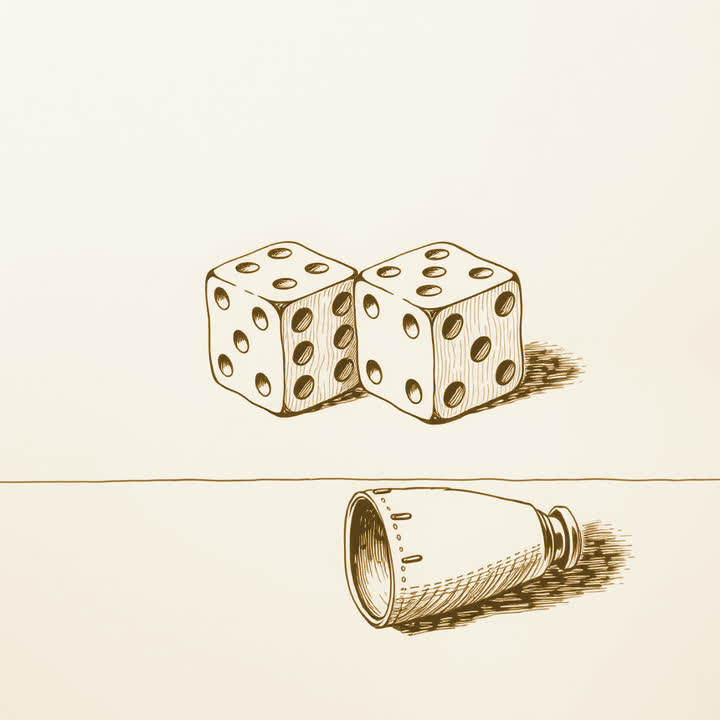
A gambler works out the odds on God.
Blaise Pascal helped invent the maths of probability in 1654, writing to Pierre de Fermat about an unfinished game of chance. Then he turned the same tool on the largest question he knew. If you cannot know whether God exists, he asked, how should you bet?
His answer is laid out like a betting table.
Believe, and if God exists you gain an infinite reward. If not, you have lost very little. Refuse, and if God exists you lose everything. If not, you have gained very little. One column is infinite and the other is small change. The bet makes itself.
He never published it. It was found in his papers.
Pascal died in 1662, and his notes for an unfinished defence of Christianity came out in 1670 as the Pensees. The wager is a few pages of it, written for the worldly sceptics he wanted to reach. Philosophers now call it one of the first pieces of decision theory.
The first objection arrived quickly. Which God?
Denis Diderot pointed out that an imam could run the same argument, word for word. If several faiths each promise an infinite reward and forbid the others, the sums no longer point anywhere. Infinity with a choice of gods is not a decision. It is a shrug.
The second objection is simpler. Nobody can believe on command.
Try believing there is a horse behind you. You cannot do it merely because it would pay. Pascal saw this coming and answered it. Take holy water, he said, have masses said, act as though you believed, and belief will follow. Whether that counts as belief is where the argument still sits.
So keep the shape of the argument and drop the theology.
When one outcome is ruinous and the guard against it is cheap, the size of the stake can decide for you, even at low odds. That is the honest core, and it is why we have seatbelts, backups and insurance. Just watch for the version that offers you one door when the corridor is full of them.
Sources
- Pascal’s Wager, Stanford Encyclopedia of Philosophy. The argument set out formally, with the many gods objection, the problem of choosing to believe, and the modern work on infinite payoffs.
- Pensees, Blaise Pascal, published 1670. The unfinished notes, published eight years after he died. Short fragments, often brilliant, and the wager is one of them. This page explains the structure.
- Blaise Pascal, Wikipedia. The mathematician before the theologian, including the letters with Fermat that got probability started and the machine he built for his father.
Nearby ideas
- The St Petersburg paradox. A huge prize is worth less to you than its average suggests.
- The veil of ignorance. Write the rules as if you did not know which seat you would get.
- The trolley problem. Why harm that follows from a plan feels different from harm that is the plan.
- Kuhn’s paradigm shifts. How science changes, not step by step, but by revolution.
- Galileo’s ship. Why you cannot feel steady motion from the inside.
- Eratosthenes measures the Earth. How a shadow and some arithmetic measured the size of the Earth.
- The sorites paradox. Vague words have no edges, but rules force them to have one.
- Zeno’s paradoxes. Endless steps can still add up to a finish line.