Cobra Effect · Human origins
The small humans of Flores
How a tiny skeleton on an Indonesian island turned out to be a distinct human species.
7 cards, read aloud in 2:41, with a test and sources.
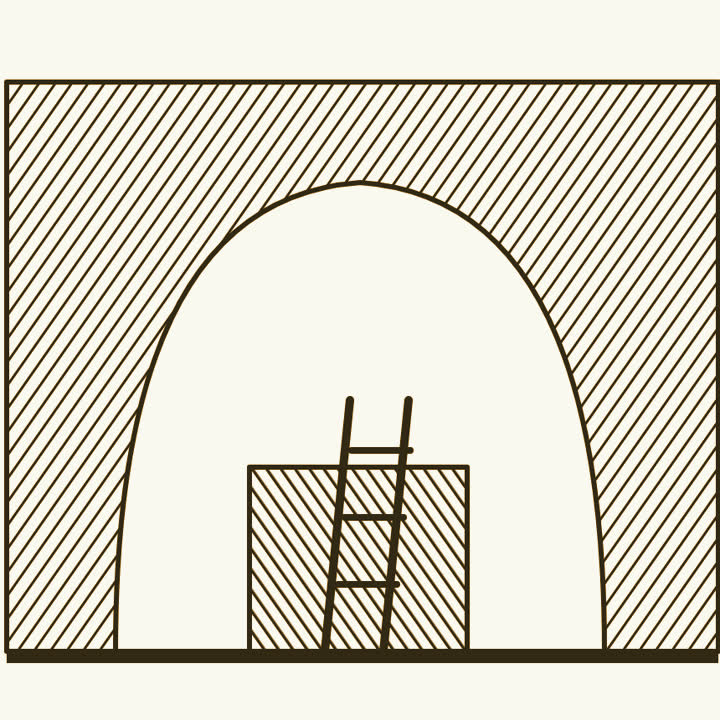
In 2003, a team digging in a cave on the Indonesian island of Flores found a tiny skeleton.
The cave is called Liang Bua. The dig was a joint Australian and Indonesian project, co-led by the archaeologist Mike Morwood. The skeleton belonged to an adult female, about a metre tall.
In 2004, the team announced a new species of human.
They named it Homo floresiensis. Its brain was roughly a third the size of ours, about as big as a chimpanzee’s. Newspapers quickly nicknamed the tiny people hobbits.
Many scientists were doubtful.
Some argued the skeleton was a modern human with a disorder that stunts growth and brain size. The argument went on for years. Remains of other small individuals were found in the cave too.
At first, the bones were thought to be astonishingly recent.
Early dating suggested the species had survived until around twelve thousand years ago. In 2016, a fresh study of the cave’s layers revised that. The bones are now dated to between about a hundred thousand and sixty thousand years ago. Stone tools linked to the species go back further, and continue until about fifty thousand years ago.
Also in 2016, older fossils turned up at another site on Flores.
At a place called Mata Menge, researchers found a jaw fragment and teeth about seven hundred thousand years old. They came from small individuals too, as small as the Liang Bua skeleton or smaller. So small bodies on Flores went back a very long way.
Most scientists now accept the hobbits as a distinct human species.
How they came to be so small is still debated. Some think they descend from Homo erectus, and shrank over many generations on the island. Others think they come from an even older, smaller kind of human. Islands can push large animals toward smaller bodies, as with the small elephant relatives that also lived on Flores.
So when a find seems too strange to be true, ask what further evidence would settle it.
A single odd skeleton could be explained away as illness. More fossils, better dating and older finds turned a puzzle into a species. Strange claims deserve both doubt and a proper search for evidence.
Sources
- Homo floresiensis, Smithsonian Human Origins Program. What is known about the species, and the debate over it.
- A 700,000 year old fossil find shows the hobbits’ ancestors were even smaller, University of Wollongong. The older fossils from Mata Menge.
- Hobbits of Flores, Indonesia, Smithsonian Human Origins Program. The excavations at Liang Bua.
Nearby ideas
- The ancient people known from a finger bone. How a tiny finger bone revealed a whole branch of the human family.
- Lucy, the ancestor who walked upright. How a skeleton from Ethiopia showed that walking upright came before big brains.
- Footprints in volcanic ash. How footprints in ancient ash captured upright walkers, and what they cannot tell us.
- The fossil that fooled experts for forty years. How a forged skull fooled many experts, and how it was finally exposed.
- The mother of all our mothers. What the woman nicknamed Mitochondrial Eve really was, and what the name got wrong.
- The Neanderthal inside us. How ancient DNA revealed that many living people carry a little Neanderthal in them.