Cobra Effect · Human origins
Lucy, the ancestor who walked upright
How a skeleton from Ethiopia showed that walking upright came before big brains.
7 cards, read aloud in 2:38, with a test and sources.
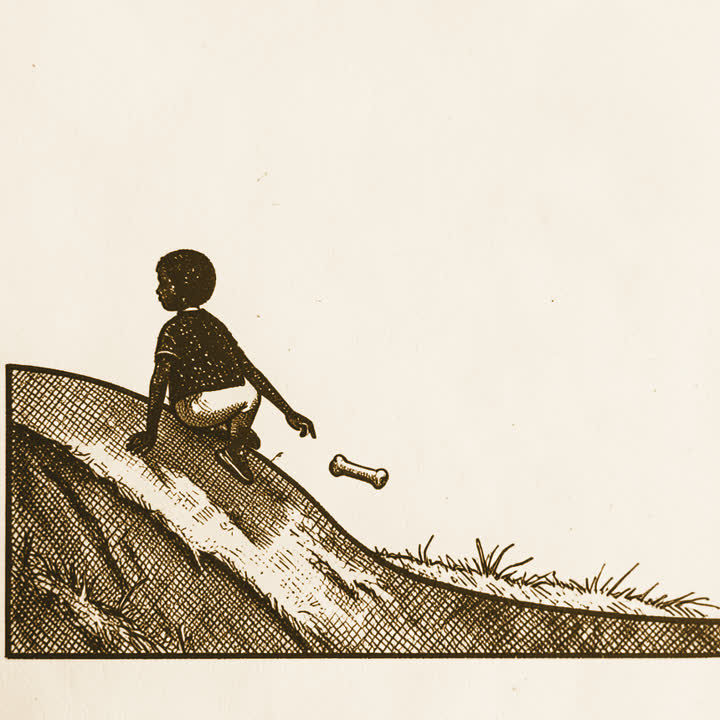
In November 1974, Donald Johanson spotted a small piece of arm bone in a gully in Ethiopia.
He was searching the dry hills of Hadar, in the Afar region, with a student called Tom Gray. Nearby, they found more bones from the same skeleton. Over the following weeks, the team gathered several hundred pieces.
The pieces made up about forty percent of one skeleton.
She was a small adult female, a little over a metre tall and weighing under thirty kilograms. She lived about 3.2 million years ago. Layers of volcanic ash above and below the bones were dated to work out her age.
That night, a Beatles song was playing again and again at the camp.
The song was Lucy in the Sky with Diamonds. Someone suggested the name Lucy, and it stuck. In Ethiopia she is also called Dinkinesh, which means you are marvellous.
Her bones showed that she walked on two legs.
Her thigh bone angled inward toward the knee, as ours does. Her pelvis was short and broad, shaped for walking upright. Yet her arms were long and strong, and her finger bones curved, suggesting she also climbed. Her species had a small brain, not much larger than a chimpanzee’s.
Lucy showed that walking upright came long before big brains.
Many had assumed that our ancestors grew large brains first, and stood up later. Her species walked on two legs millions of years before brains grew large. In 1978, the species was named Australopithecus afarensis.
Lucy is not the oldest human ancestor, or a missing link.
Older fossils of upright walking relatives have since been found. Human evolution is more like a branching bush than a single chain. In 2016, one team argued from her fractures that she died falling from a tree. Others, including Johanson, say the cracks formed after burial.
So when one find overturns an assumption, ask what else the assumption shaped.
Scientists had pictured the big brain coming first. A small skeleton with upright legs and a small brain changed the order of the story. Her bones are kept at the National Museum of Ethiopia, in Addis Ababa.
Sources
- Lucy’s Story, Institute of Human Origins, Arizona State University. The discovery, the name, and what her bones show.
- AL 288-1, Smithsonian Human Origins Program. The fossil record entry for Lucy.
- Did Lucy die falling from a tree?, National Geographic. The 2016 claim, and why others disagree.
Nearby ideas
- Footprints in volcanic ash. How footprints in ancient ash captured upright walkers, and what they cannot tell us.
- The fossil that fooled experts for forty years. How a forged skull fooled many experts, and how it was finally exposed.
- The mother of all our mothers. What the woman nicknamed Mitochondrial Eve really was, and what the name got wrong.
- The Neanderthal inside us. How ancient DNA revealed that many living people carry a little Neanderthal in them.
- The ancient people known from a finger bone. How a tiny finger bone revealed a whole branch of the human family.
- The small humans of Flores. How a tiny skeleton on an Indonesian island turned out to be a distinct human species.