Cobra Effect · Human origins
The mother of all our mothers
What the woman nicknamed Mitochondrial Eve really was, and what the name got wrong.
7 cards, read aloud in 2:29, with a test and sources.
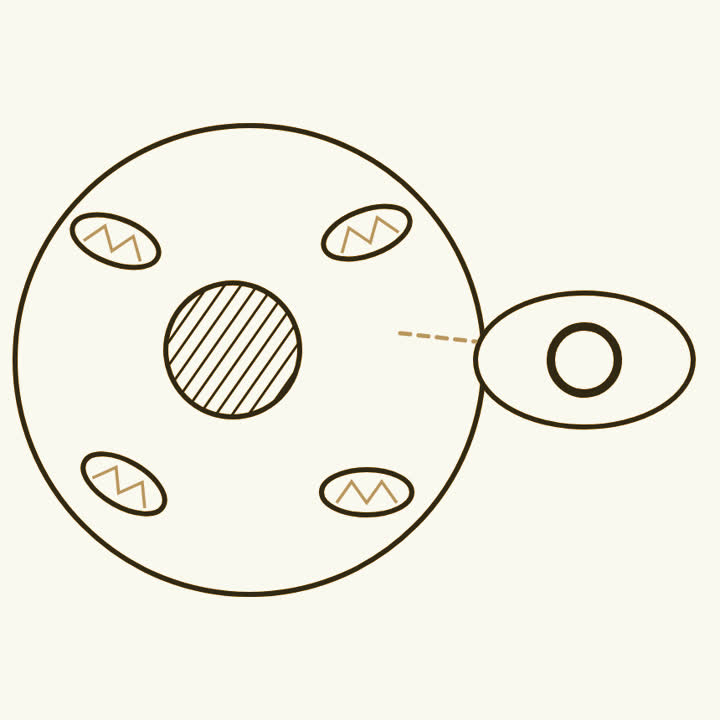
Inside your cells are mitochondria, each with a small loop of DNA of its own.
You inherit that DNA almost entirely from your mother. She got it from her mother, and so on back through the generations. So tracing it back follows a single line of mothers.
In 1987, three scientists compared mitochondrial DNA from people around the world.
Rebecca Cann, Mark Stoneking and Allan Wilson worked at the University of California, Berkeley. They studied a hundred and forty seven people from five regions, mostly using placentas donated after births. From the differences in their DNA, they built a family tree.
All the lines traced back to one woman, probably in Africa.
She lived very roughly two hundred thousand years ago. The deepest branches of the tree were among people of African descent. The finding supported the idea that modern humans arose in Africa and spread from there.
Newspapers and magazines soon called her Mitochondrial Eve.
The scientists had not used that name in their paper. It led many people to imagine she was the first woman, or the only woman alive.
But she was neither the first woman, nor the only one.
Many other women lived at the same time, and many of them are our ancestors too. She is simply the most recent woman from whom everyone alive descends through an unbroken line of mothers. Other women’s lines of mothers ended whenever a generation had only sons, or no children.
Later studies refined the picture.
The 1987 methods were criticised, and the work was redone with more data and better methods. Estimates of when she lived now range from about a hundred thousand to over two hundred thousand years ago. The evidence for an African origin of modern humans has grown stronger.
So when a headline gives a finding a catchy name, ask what the name leaves out.
The name Eve suggested a first woman, alone. The science described one line of mothers among countless ancestors. A vivid name can make a careful finding sound like something it is not.
Sources
- Mitochondrial DNA and Human Evolution (1987), The Embryo Project Encyclopedia. What Cann, Stoneking and Wilson did and found.
- Mitochondrial Eve, Wikipedia. What the term means, estimates of her age, and common misunderstandings.
- Ancient DNA and Neanderthals, Smithsonian Human Origins Program. How genetics shapes the story of human origins.
Nearby ideas
- Footprints in volcanic ash. How footprints in ancient ash captured upright walkers, and what they cannot tell us.
- Lucy, the ancestor who walked upright. How a skeleton from Ethiopia showed that walking upright came before big brains.
- The Neanderthal inside us. How ancient DNA revealed that many living people carry a little Neanderthal in them.
- The ancient people known from a finger bone. How a tiny finger bone revealed a whole branch of the human family.
- The small humans of Flores. How a tiny skeleton on an Indonesian island turned out to be a distinct human species.
- The fossil that fooled experts for forty years. How a forged skull fooled many experts, and how it was finally exposed.