Cobra Effect · Human origins
Footprints in volcanic ash
How footprints in ancient ash captured upright walkers, and what they cannot tell us.
7 cards, read aloud in 2:38, with a test and sources.
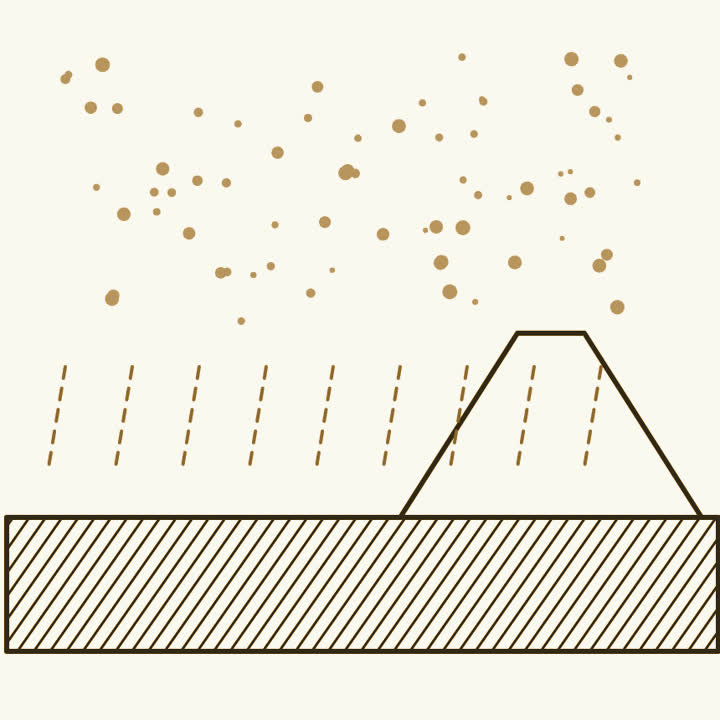
Millions of years ago, a volcano near Laetoli, in Tanzania, dusted the land with fine ash.
That was about 3.6 million years ago. The ash was dampened, and animals walked across the soft surface. More ash then fell and buried their tracks.
In 1976, members of Mary Leakey’s team found animal tracks in the hardened ash.
According to one account, they noticed them while diving for cover during a playful fight with dried elephant dung. Thousands of animal prints turned up in the years that followed. The team kept searching the ash beds.
In 1978, they uncovered a trail of footprints made by upright walkers.
It ran for more than twenty metres, with about seventy prints. The prints were made by at least three individuals, one partly stepping in another’s tracks. Paul Abell, a member of the team, is credited with spotting the first of these prints.
The prints look remarkably like our own.
The big toe lines up with the other toes, instead of sticking out to the side like an ape’s. The heel struck first, then the weight rolled forward to the toes. The walkers were probably of the species Australopithecus afarensis, whose fossils come from the same layers.
Popular pictures often show a family holding hands, but the prints cannot tell us that.
We do not know how the walkers were related, or whether they touched. In 2015, more prints on the same ancient surface were found about a hundred and fifty metres away. One of those walkers was estimated to be much larger, suggesting big differences in size within the species.
The footprints have needed protecting.
After excavation, the trail was reburied to shield it from the weather. In the 1990s, tree roots were found damaging it, and conservators worked to save it before burying it again. In 2021, a fresh look at other prints found in 1976 suggested that a second kind of upright walker had passed by.
So when evidence shows what happened, be careful about adding what it cannot show.
The footprints show upright walking, clearly and directly. They do not show who the walkers were to each other. A good story sticks to what the evidence supports.
Sources
- Laetoli Footprint Trails, Smithsonian Human Origins Program. The trails, their age, and what they show.
- New footprints from Laetoli, eLife, 2016. The prints found in 2015, including one much larger walker.
- Laetoli Footprints, NOVA, PBS. How the prints compare with human and chimpanzee feet.
Nearby ideas
- Lucy, the ancestor who walked upright. How a skeleton from Ethiopia showed that walking upright came before big brains.
- The fossil that fooled experts for forty years. How a forged skull fooled many experts, and how it was finally exposed.
- The mother of all our mothers. What the woman nicknamed Mitochondrial Eve really was, and what the name got wrong.
- The Neanderthal inside us. How ancient DNA revealed that many living people carry a little Neanderthal in them.
- The ancient people known from a finger bone. How a tiny finger bone revealed a whole branch of the human family.
- The small humans of Flores. How a tiny skeleton on an Indonesian island turned out to be a distinct human species.