Cobra Effect · Human origins
The fossil that fooled experts for forty years
How a forged skull fooled many experts, and how it was finally exposed.
7 cards, read aloud in 2:31, with a test and sources.
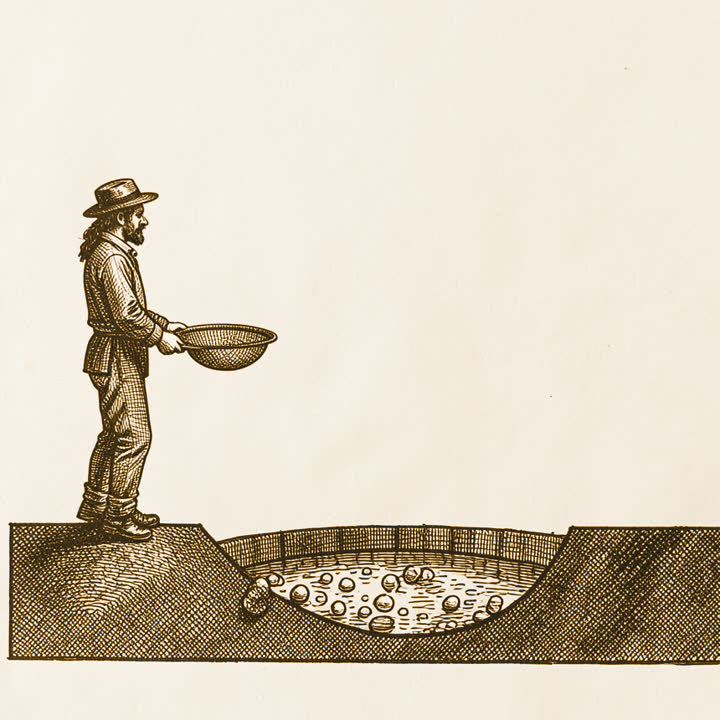
In 1912, an amateur collector brought skull fragments from a gravel pit in Sussex.
Charles Dawson was a solicitor who collected fossils in his spare time. He took the pieces to Arthur Smith Woodward, the keeper of geology at the Natural History Museum in London. The gravel pit was at Piltdown, in the south of England.
In December 1912, Woodward and Dawson unveiled Piltdown Man.
The skull looked human, with a large braincase. The jaw looked like an ape’s. It seemed to show that big brains had come early in human evolution.
Not everyone was convinced.
In 1913, the anatomist David Waterston argued in the journal Nature that it was an ape’s jaw with a human skull. In 1915, Dawson reported a second set of remains from a different site. Dawson died in 1916, and no more finds were ever made.
Over the following decades, Piltdown Man fitted less and less.
Fossils from Africa and Asia showed ancestors with small brains and human-like teeth, the reverse of Piltdown. In 1949, Kenneth Oakley of the Natural History Museum tested the bones for fluorine. Bones buried longer soak up more fluorine, and these turned out to be far younger than claimed.
In 1953, Oakley, Joseph Weiner and Wilfrid Le Gros Clark exposed the fraud.
The jaw came from an ape, and its teeth had been filed down to look human. The bones had been stained brown to look ancient. The skull was human, but only centuries old.
In 2016, a new study examined the pieces with modern methods.
DNA showed that the teeth came from a single orangutan. The same methods of faking had been used at both sites, pointing to one forger. The researchers concluded the forger was most likely Dawson, though it cannot be proved beyond doubt.
So when a find fits exactly what people hoped for, ask whether that is a warning sign.
Piltdown matched what many experts expected to find. That made it easier to accept, and harder to question. Evidence that flatters our expectations deserves the closest look of all.
Sources
- New genetic and morphological evidence suggests a single hoaxer created Piltdown man, Royal Society Open Science, 2016. The modern study of how the forgery was made.
- Piltdown Man, Wikipedia. The full history, from the find to the exposure.
- Piltdown Man: Charles Dawson likely fraudster, Natural History Museum. The museum’s account of the 2016 findings.
Nearby ideas
- Lucy, the ancestor who walked upright. How a skeleton from Ethiopia showed that walking upright came before big brains.
- The mother of all our mothers. What the woman nicknamed Mitochondrial Eve really was, and what the name got wrong.
- The Neanderthal inside us. How ancient DNA revealed that many living people carry a little Neanderthal in them.
- The ancient people known from a finger bone. How a tiny finger bone revealed a whole branch of the human family.
- The small humans of Flores. How a tiny skeleton on an Indonesian island turned out to be a distinct human species.
- Footprints in volcanic ash. How footprints in ancient ash captured upright walkers, and what they cannot tell us.