Cobra Effect · Science and philosophy
Zeno’s paradoxes
Endless steps can still add up to a finish line.
7 cards, read aloud in 2:43, with a test and sources.
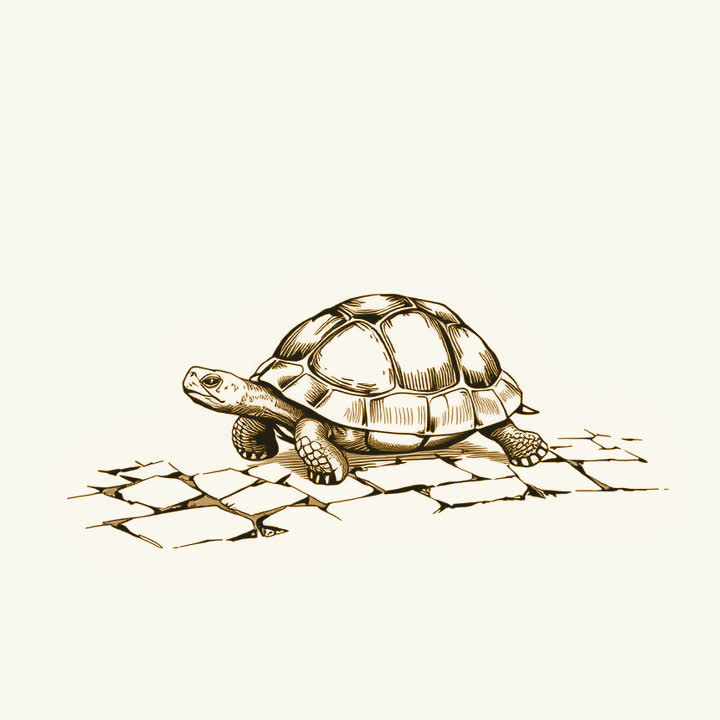
Achilles gives a tortoise a head start. He can never catch it.
That is the claim, and it held up for two thousand years. By the time Achilles reaches where the tortoise was, the tortoise has moved on a little. He reaches that spot. It has moved again. Repeat forever.
Zeno of Elea, around the fifth century BC.
He was defending his teacher, who held that change and motion are illusions. His method was to accept your view and then show that it leads somewhere absurd. We have most of it secondhand, through Aristotle, who wrote the puzzles down in order to answer them.
The worse one. You cannot even start walking.
To cross a room you must first cross half of it. To cross that half you must first cross half of that. And half of that. There is no first step, because every step has a smaller one before it. Yet here you are, at the door.
Endlessly many pieces can add up to a finite thing.
A half, then a quarter, then an eighth, then a sixteenth. Add them all and you get one. Not nearly one. One. The times add up the same way, and they add up to the few seconds it actually takes. The series has no last term and a perfectly ordinary sum.
So Achilles catches the tortoise, at a time you can calculate.
The puzzles look like they show that motion is impossible. What they actually showed was that the arithmetic of the endless was missing. It took until the 19th century for mathematicians to put limits on a firm footing.
And here is what the mathematics did not settle.
Whether it makes sense to finish endlessly many separate tasks is still argued about. Whether space and time really divide forever, or stop somewhere very small, is a question for physics. The sum is not a proof that the world is smooth. It is a proof that the arithmetic was never the problem.
What to take from a dead Greek with a tortoise.
When an argument lands somewhere absurd, one of the steps is wrong, and it is usually the one nobody stated. Zeno’s hidden step was that endlessly many pieces must add to something endless. So when you are sure of every step and the conclusion is mad, go hunting for the assumption you never wrote down.
Sources
- Zeno’s Paradoxes, Stanford Encyclopedia of Philosophy. All of the puzzles, what Aristotle said about them, and the modern mathematical and philosophical replies. Long, and the first two sections stand alone.
- Physics, Aristotle. Book six is where the puzzles are written down and answered. Almost everything we know about Zeno survives because Aristotle wanted to argue with him.
- Zeno’s paradoxes, Wikipedia. A quick tour of Achilles, the dichotomy, the arrow and the rest, with the geometric series worked through.
Nearby ideas
- The sorites paradox. Vague words have no edges, but rules force them to have one.
- The St Petersburg paradox. A huge prize is worth less to you than its average suggests.
- The ship of Theseus. Replace every part, and ask whether it is still the same thing.
- The experience machine. Would you trade real life for guaranteed happy feelings?
- The nirvana fallacy. Rejecting a good plan for not being perfect keeps a worse one.
- Falsifiability. A claim that nothing could disprove tells you nothing.
- The problem of induction. A long run of past successes cannot prove the next one.
- The trolley problem. Why harm that follows from a plan feels different from harm that is the plan.