Cobra Effect · Science and philosophy
Eratosthenes measures the Earth
How a shadow and some arithmetic measured the size of the Earth.
7 cards, read aloud in 2:45, with a test and sources.
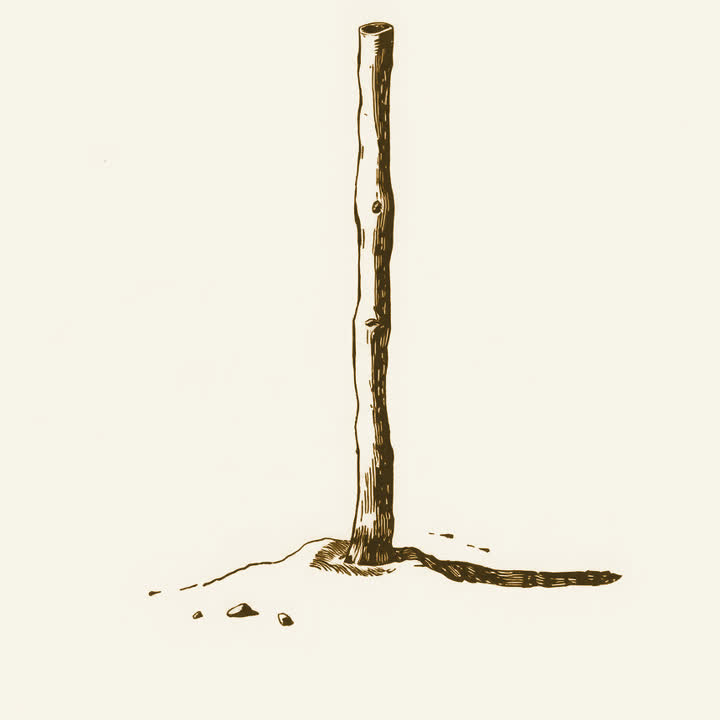
A man in Egypt measures the whole Earth with a stick.
He never leaves the country. He has no ship, no instrument worth the name, and no idea what is on the other side. He has a shadow, a well, and a distance he can look up.
Eratosthenes runs the great library at Alexandria, around 240 BC.
He is a geographer, a poet and a mathematician. And he has read something odd about a town far up the Nile called Syene. On one day of the year, at noon, the sun shines straight down to the bottom of a deep well there.
That means the sun is directly overhead. In Alexandria it never is.
At the same hour, on the same day, a rod standing upright in Alexandria casts a shadow. A short one, but a real one. On a flat Earth, with the sun far away, both rods would cast the same shadow. They don’t.
He measures the angle of that shadow. About 7.2 degrees.
Which is a fiftieth of a full circle. So the road from Alexandria to Syene is a fiftieth of the way around the Earth. That road was reckoned at about 5,000 stadia. Multiply by fifty and you get 250,000 stadia. The size of the planet, from a shadow.
How close was he? That depends on a unit nobody is sure about.
A stadion was the length of a running track, and different places used different tracks. On the short stadion he lands within a couple of percent of the real figure. On the long one he is out by about a sixth. Either way, a man with a stick got the size of the world roughly right.
The famous version of the story is tidier than the evidence.
We have it mostly from Cleomedes, writing a long time afterwards. The well, the exact day and the round numbers may be a good teacher’s retelling. The method survives the doubt. One angle, one distance, one assumption about the sun.
You can do this, and it is the most useful trick in science.
Find one thing you can measure. Find how it is tied to the thing you cannot. Then multiply, and say out loud how wrong you might be. A rough number you can defend beats a precise number you made up. Go and measure something with a stick.
Sources
- Eratosthenes, Wikipedia. The man, the measurement, and the long argument about how long a stadion was and therefore how accurate he really was. Read the section on the circumference of the Earth first.
- Geographica, Strabo. A survey of the known world written in the reign of Augustus. Much of what we have of Eratosthenes survives only because Strabo quoted him and then argued with him.
- Earth’s circumference, Wikipedia. Everyone who has tried to measure the planet, from the Greeks to the satellites, and how far each of them got.
Nearby ideas
- Fermi estimation. Break an impossible question into small guesses you can make.
- First principles. Rebuild a problem from what must be true, not from what everyone does.
- The map is not the territory. Every model leaves something out, and that is where it fails.
- The sorites paradox. Vague words have no edges, but rules force them to have one.
- Zeno’s paradoxes. Endless steps can still add up to a finish line.
- The experience machine. Would you trade real life for guaranteed happy feelings?
- The nirvana fallacy. Rejecting a good plan for not being perfect keeps a worse one.
- Falsifiability. A claim that nothing could disprove tells you nothing.