Cobra Effect · Science and philosophy
The sorites paradox
Vague words have no edges, but rules force them to have one.
7 cards, read aloud in 2:38, with a test and sources.
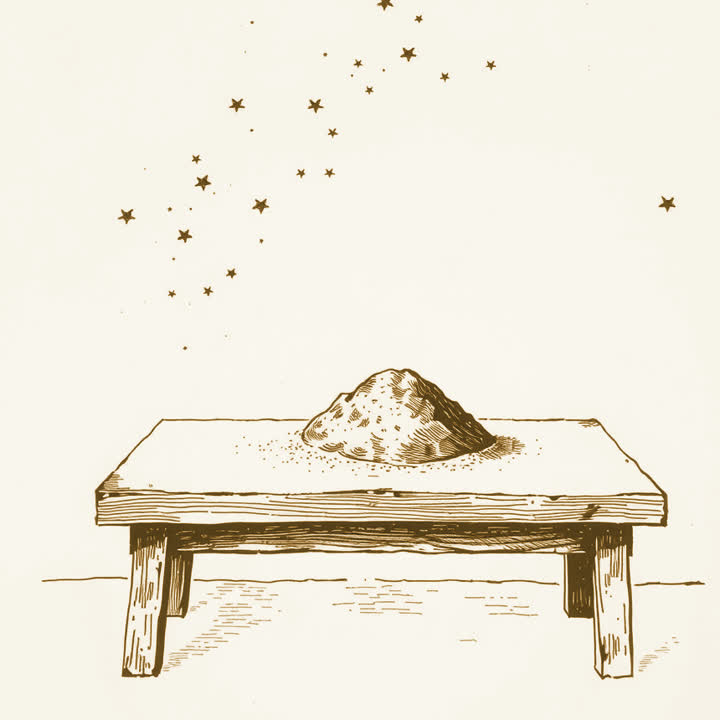
A thousand grains of sand on a table. That is a heap.
Take one grain away. Still a heap. Obviously. Nobody would say that removing a single grain turns a heap into something else. So take another.
Keep going. Somewhere along the way you are holding one grain.
One grain is not a heap. But every single step was harmless, and you agreed to all of them. So either one of those steps ended the heap, or a heap can be one grain. Neither is acceptable.
This is the sorites paradox, from the Greek word for heap.
It is credited to Eubulides of Miletus, in the fourth century BC. He had a matching version about a bald man. Pull one hair from a full head. Still not bald. The trouble is not the sand. It is words with no edge.
Most of the useful words have no edge. Tall. Rich. Late. Safe.
You can line people up by height and never find the place where tall begins. That is fine, and it is how language is supposed to work. It stops being fine the moment somebody hangs a consequence on the line.
So we draw the line anyway, and the line does all the work.
A grant for any household earning under a certain figure. A pass mark. A speed limit. The person a pound above and the person a pound below are almost identical. They get completely different outcomes. And everybody learns to sit just on the right side of it.
There is no agreed answer to this, and that is worth knowing.
Some philosophers say there is a sharp line and we simply cannot know where it falls. Some say truth comes in degrees, so a claim can be half true. Some say the word is just not defined out there in the middle. Two and a half thousand years. Still open.
What to do when a rule needs a line.
Expect the line to be arbitrary, and say so out loud rather than defending it. Then look at the people standing just either side of it. If their outcomes differ wildly, soften the edge or spread the consequence across it. A sharp rule on a blurry word will always be unfair somewhere.
Sources
- Sorites Paradox, Stanford Encyclopedia of Philosophy. The full survey, from Eubulides to the modern replies. Heavy going in the later sections and the opening is plain enough for anyone.
- Vagueness, Timothy Williamson, 1994. The case that there really is a sharp line between a heap and a non heap, and that we simply cannot know where it falls. This page covers the idea and where his book sits in the argument.
- Sorites paradox, Wikipedia. The puzzle, the bald man version, and a short tour of the main ways philosophers have tried to escape it.
Nearby ideas
- The ship of Theseus. Replace every part, and ask whether it is still the same thing.
- Zeno’s paradoxes. Endless steps can still add up to a finish line.
- The map is not the territory. Every model leaves something out, and that is where it fails.
- The experience machine. Would you trade real life for guaranteed happy feelings?
- The nirvana fallacy. Rejecting a good plan for not being perfect keeps a worse one.
- Falsifiability. A claim that nothing could disprove tells you nothing.
- The problem of induction. A long run of past successes cannot prove the next one.
- The trolley problem. Why harm that follows from a plan feels different from harm that is the plan.