Cobra Effect · Famous myths
Does a photon experience no time?
What slow clocks really show, and why light has no point of view to see from.
7 cards, read aloud in 4:23, with a test and sources.
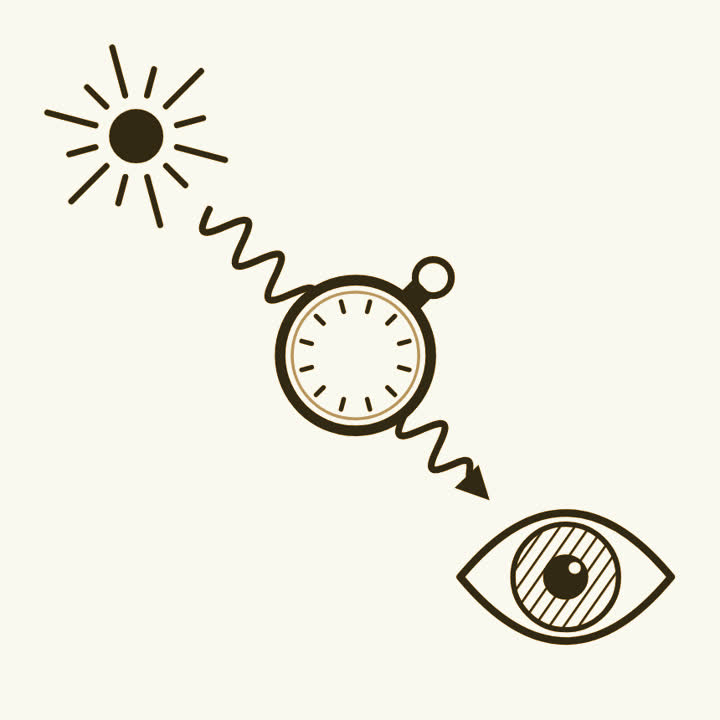
Starlight takes years to reach your eye. For the light itself, people say, no time passes.
The claim turns up in popular science again and again. From the point of view of a photon, a single packet of light, its journey is instant. It leaves the star and lands in your eye in the same moment, with the whole trip squeezed to nothing. It sounds like the deepest fact in physics. Part of it is true. But the part about the photon’s point of view is not even wrong. It has no meaning.
The claim starts from something real. A fast clock ticks slowly.
Einstein showed it in 1905, and it has been measured many times. Particles called muons fall apart after about two millionths of a second. Sent around a ring at CERN in 1977, at more than 99.9 percent of the speed of light, they lasted about 29 times longer. The faster the clock, the slower it ticks, as judged by someone watching it go by. Close to the speed of light, the slowing grows without limit. So people take one more step. At the speed of light itself, they say, the clock must stop.
That last step is where it goes wrong.
The rule for slow clocks divides by a number that shrinks as the speed rises. At the speed of light, that number is zero. Dividing by zero does not give zero, and it does not give infinity. It gives no answer at all. And every one of those measurements used something with mass, which can approach the speed of light but never reach it. The trend is real. The end point is never arrived at.
There is a deeper problem. Light has no point of view.
A point of view, in relativity, means a place to stand where the thing is at rest. But the theory begins from the rule that light moves at the same speed for every observer. A view in which light stands still would break the rule the whole theory is built on. Einstein later recalled wondering, at sixteen, what he would see if he chased a light beam at its own speed. A frozen wave, it seemed, and nothing like that exists. A long running online physics guide puts it more bluntly. Photons do not have experiences.
Here is the part that is true.
In 1908 Hermann Minkowski showed that space and time can be combined into a single measure of the separation between two events. Observers moving differently disagree about the time between two events, and about the distance. They all agree on this combined measure. For a traveller slower than light, it equals the time on the traveller’s own watch. For a flash of light leaving a star and landing in your eye, it is exactly zero, for everyone. That zero is real. But there is no watch, and no traveller, for it to be the time of.
Some particles change as they fly. Light does not.
Neutrinos are ghostly particles that come in three kinds, and they change from one kind to another as they travel. That was shown in Japan in 1998 and in Canada in 2001 and 2002, and it won the Nobel Prize in 2015. The theory only allows such changes if neutrinos have mass. Anything with mass travels slower than light, so time passes for it. Light carries nothing like that. A photon crossing empty space arrives exactly as it left, so there is nothing in it that could serve as a clock.
So when someone tells you what a photon experiences, ask whose clock they mean.
Every statement about time in relativity is about some clock, carried by something that can be at rest. Light can never be at rest, so no clock can ride with it. What is true is simpler and stranger. Along the path of a light ray, the separation that all observers agree on is zero. What the photon feels has no answer in the theory. Not zero. No answer.
Sources
- I am going at the speed of light and I turn on my headlights, Philip Gibbs, Usenet Physics FAQ, hosted by John Baez. Why there is no point of view at the speed of light, in a single page.
- Chasing the Light: Einstein’s Most Famous Thought Experiment, John D. Norton, University of Pittsburgh. What the sixteen year old’s puzzle could and could not have shown, from a historian of physics.
- Spacetime, Wikipedia. The combined measure of separation, why everyone agrees on it, and why it is zero along a light ray. The article itself repeats the popular claim in passing.
- Nobel Prize: Neutrinos Oscillate, Philip Ball, APS Physics magazine, 2015. How particles that change identity in flight showed that neutrinos have mass.
Nearby ideas
- Moving clocks run slow. Why moving clocks run slow, and how muons and airliners proved it.
- The constant speed of light. Why light is measured at the same speed by everyone, however they move.
- Is the Planck length the smallest possible length?. Where the smallest length came from, and what has actually been measured.
- Do we only use ten percent of our brains?. How a vague remark and a book foreword became the ten percent brain myth.
- The tongue map that was never true. How a misread graph put a map of taste zones into school textbooks.
- Does old window glass flow downhill?. Why old window panes are uneven, and why it is not because glass flows.
- Did Vikings wear horned helmets?. How horned Viking helmets came from an opera costume designer, not from history.
- Did Einstein fail maths?. How a real exam failure turned into the myth that Einstein failed maths.