Cobra Effect · Relativity
The constant speed of light
Why light is measured at the same speed by everyone, however they move.
7 cards, read aloud in 3:18, with a test and sources.
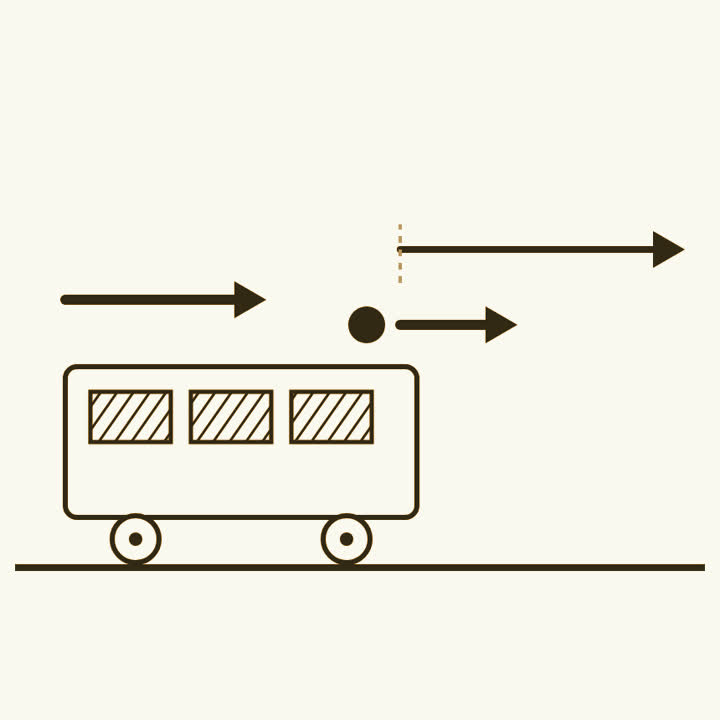
Throw a ball forward from a moving train, and it goes faster than your throw.
Add the train’s speed to the speed of your throw, and you have the ball’s speed along the track. Speeds add. It is so obvious that nobody bothers to say it. So light shone forward from something moving should go faster too. And the Earth is moving, around the Sun, at about 30 kilometres every second.
In 1887 two Americans set out to measure that extra speed.
Albert Michelson and Edward Morley split a beam of light in two and sent the halves off at right angles. Mirrors bounced each half back, and the two were brought together again. If the Earth’s motion sped light up in one direction, the returning halves would fall out of step. The instrument sat on a stone slab floating on mercury, so it could be turned smoothly in any direction.
They found nothing.
Whichever way they turned the instrument, the two halves came back exactly in step. Light went at the same speed in every direction, as if the Earth were standing still. The instrument could have seen a difference far smaller than the one they expected. Later versions, far more precise, have found nothing either.
In 1905 Albert Einstein took the result at its word.
The speed of light is the same for everyone, he said, however they are moving. Not roughly the same. Exactly the same. Chase a beam at nearly its own speed, and you still measure it racing away from you at full speed. He kept an older rule too, that steady motion cannot be detected from the inside.
If light will not add up, time has to give.
A passenger flashes a light in the middle of a moving carriage. For the passenger, it reaches both ends at the same moment. For someone on the platform, the back of the carriage runs into the light first, and the front runs away from it. Both are right. Whether two things happen at the same time depends on how you are moving.
Light from something moving at nearly its own speed still arrives at the usual speed.
In 1964, at CERN, physicists made particles flying at more than 99 percent of the speed of light. As the particles broke apart, they gave off flashes of light. The team timed those flashes between two detectors placed far apart. They travelled at the ordinary speed of light, not a fraction faster.
So when a result looks impossible, ask which assumption nobody ever tested.
The nothing that Michelson and Morley found was a real answer. Einstein kept it, and gave up the idea that time runs the same for everyone. Since 1983, the metre itself has been defined by how far light travels in a set fraction of a second. The speed of light is no longer something we measure. It is what everything else is measured against.
Sources
- Relativity: The Special and the General Theory, Albert Einstein, 1916. Einstein’s own short explanation for general readers, starting with trains, embankments and flashes of light. Free to read online.
- Michelson–Morley experiment, Wikipedia. How the instrument worked, why a difference was expected, the result of 1887, and the far more precise versions that followed.
- Special relativity, Wikipedia. Einstein’s two starting rules of 1905, why events at the same time for one person are not for another, and the tests since.
Nearby ideas
- Galileo’s ship. Why you cannot feel steady motion from the inside.
- Moving clocks run slow. Why moving clocks run slow, and how muons and airliners proved it.
- Mass and energy are the same thing. Why mass and energy are the same thing, and why a gram holds so much.
- Falling feels like floating. Why falling feels like floating, and how that led Einstein to gravity.
- Gravity bends light. Why starlight bends around the Sun, and how a 1919 eclipse proved it.
- Gravity slows time. Why clocks run slower in stronger gravity, and why GPS has to allow for it.
- Space itself can ripple. Why colliding black holes shake space, and how LIGO finally felt it.
- Where not even light escapes. Why some stars collapse into places light cannot leave, and how we found them.