Cobra Effect · Relativity
Where not even light escapes
Why some stars collapse into places light cannot leave, and how we found them.
7 cards, read aloud in 3:44, with a test and sources.
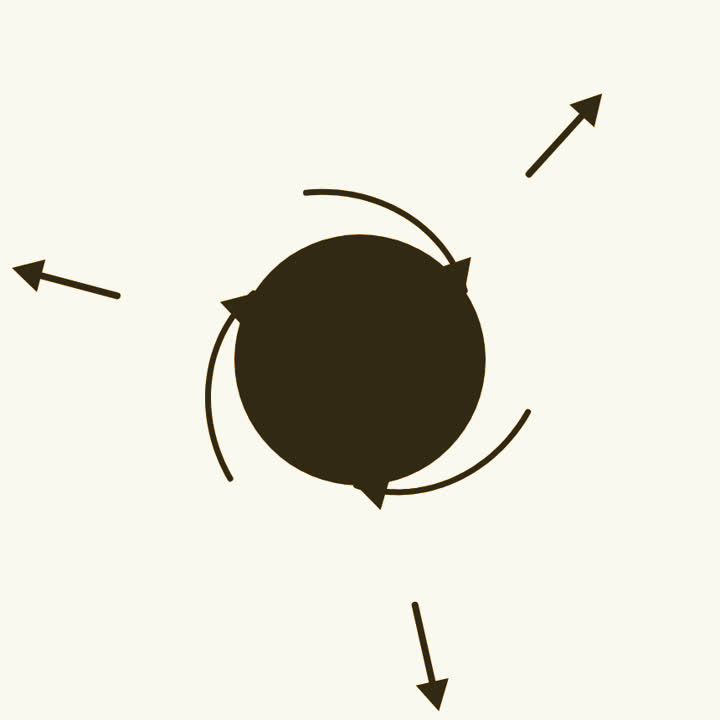
Squeeze enough mass into a small enough space, and not even light can get out.
Within weeks of Einstein publishing his theory in 1915, Karl Schwarzschild found an exact solution to its equations while serving in the German army. It described the space around a single concentrated mass, and it held a strange boundary. Inside a certain distance, every path leads inward. Nothing that crosses can ever come back out. That boundary is now called the event horizon.
To make the Sun a black hole, you would have to crush it to about 6 kilometres across.
The Sun is 1.4 million kilometres across, so that is a squeeze of more than two hundred thousand times. The Earth would have to be crushed to the size of a marble. Nothing we know of could do that to the Sun or the Earth. But when some of the heaviest stars die, their cores collapse all the way.
In the early 1970s astronomers found a giant star in orbit with something heavy and unseen.
The system, called Cygnus X-1, shines brightly in X-rays. Gas pulled off the giant star swirls around its unseen partner, heating to millions of degrees before it vanishes. The partner weighs about twenty times as much as the Sun, far too heavy to be a neutron star, yet it gives off no light of its own. It became the first black hole most astronomers accepted as real.
At the centre of our galaxy, stars race around a point that gives off no light.
Two teams, led by Reinhard Genzel and Andrea Ghez, tracked those stars for decades. One star, called S2, swings around the point every 16 years, reaching several thousand kilometres a second. Its orbit reveals about four million Suns’ worth of mass, packed into a space too small to be anything but a black hole. They shared the Nobel Prize in 2020 with Roger Penrose.
In 2019 a telescope as wide as the Earth pictured a black hole’s shadow.
The Event Horizon Telescope links radio dishes across the world so that together they act as one giant dish. It pictured the black hole in the galaxy M87, 55 million light years away and six and a half billion times the mass of the Sun. The image shows a dark shadow inside a ring of glowing gas, its light bent around the black hole by gravity. In 2022 it pictured the black hole at the centre of our own galaxy.
Watch someone fall toward a black hole, and they seem to slow down and freeze.
As they near the event horizon, their clock seems, from far away, to run slower and slower. Their light stretches redder and fades, and they never quite seem to cross. For the one falling, time runs normally, and they cross without noticing anything special. Near a small black hole, the difference in pull between their head and feet would stretch them apart long before that.
So when something seems impossible, ask whether the equations already allow it.
Black holes began as a strange corner of Einstein’s mathematics, and even he doubted they could really form. About half a century later, astronomers started finding them. Now we weigh them, hear them collide and picture their shadows. The universe took the equations more seriously than their author did.
Sources
- Black hole, Wikipedia. From Schwarzschild’s solution to the first pictures of a shadow, and what happens at the event horizon.
- Cygnus X-1, Wikipedia. The X-ray source that became the first widely accepted black hole, and how its mass was measured.
- Event Horizon Telescope, Wikipedia. How radio dishes across the world combined to picture the shadows of the black holes in M87 and at the centre of our galaxy.
Nearby ideas
- Space itself can ripple. Why colliding black holes shake space, and how LIGO finally felt it.
- Gravity slows time. Why clocks run slower in stronger gravity, and why GPS has to allow for it.
- The constant speed of light. Why light is measured at the same speed by everyone, however they move.
- Moving clocks run slow. Why moving clocks run slow, and how muons and airliners proved it.
- Mass and energy are the same thing. Why mass and energy are the same thing, and why a gram holds so much.
- Falling feels like floating. Why falling feels like floating, and how that led Einstein to gravity.
- Gravity bends light. Why starlight bends around the Sun, and how a 1919 eclipse proved it.