Cobra Effect · Relativity
Falling feels like floating
Why falling feels like floating, and how that led Einstein to gravity.
7 cards, read aloud in 3:07, with a test and sources.
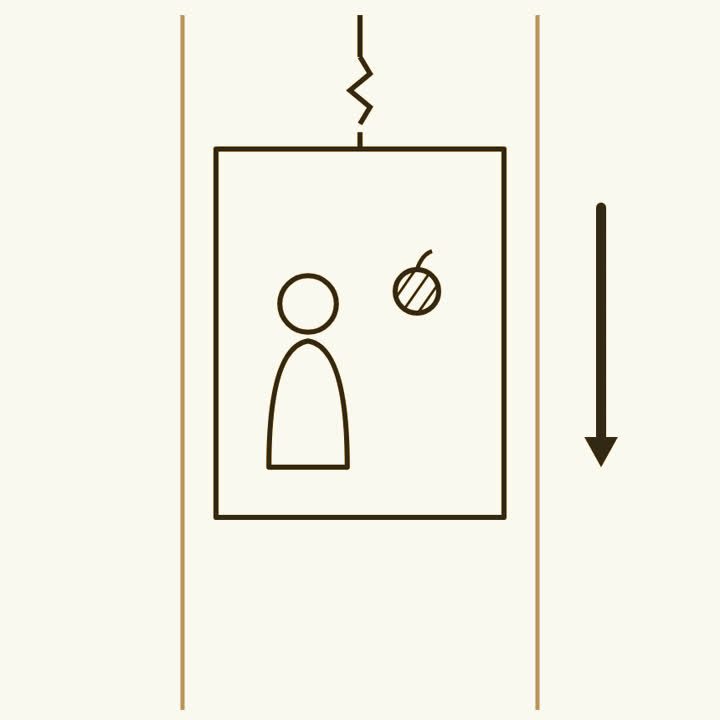
In 1907 Albert Einstein had what he later called the happiest thought of his life.
A person falling freely, he realised, would not feel their own weight. Let go of an apple as you fall, and it would float beside you. Inside a falling box, gravity seems to switch off. He spent the next eight years working out what that meant.
A hammer and a feather, dropped on the Moon, land together.
In 1971 the astronaut David Scott stood on the Moon and let go of both at once. With no air to slow the feather, they hit the ground at the same moment. Gravity makes everything fall the same way, whatever it is made of. That plain fact was the clue Einstein followed.
Now shut yourself in a windowless room in space, and fire a rocket underneath it.
The floor pushes up on your feet, and you feel heavy. Let go of a ball, and the floor rushes up to meet it. No experiment inside the room can tell this apart from standing on the ground. Einstein made that the heart of his idea. Being pushed along and being held up against gravity are the same thing.
Astronauts float not because gravity has gone, but because they are falling.
On the space station, gravity is still about nine tenths as strong as it is on the ground. The station and everyone in it are falling around the Earth together. They move sideways so fast that they keep missing it. Falling freely, they feel no weight at all.
Shine a light across that rocket pushed room, and the beam bends.
The light leaves one wall and heads straight for the far wall. While it crosses, the room speeds up beneath it, so the light arrives a little lower down. From inside, the beam curves toward the floor. If being pushed bends light, and pushing and gravity are the same, then gravity must bend light too.
The idea has been tested to a few parts in a million billion.
If two materials fell even slightly differently, the whole idea would break. Between 2016 and 2018, a French satellite called Microscope watched two cylinders of different metals fall together as it orbited. They kept pace to within a few parts in a million billion. Everything falls the same way, as far as anyone has been able to measure.
So when you feel your weight, ask what is pushing up on you.
Weight is not gravity itself. It is the floor, or the chair, stopping you from falling. Take the floor away and you feel nothing, even with gravity pulling as hard as ever. Einstein followed that thought all the way to gravity as the shape of space and time. It began with a man imagining a fall.
Sources
- Relativity: The Special and the General Theory, Albert Einstein, 1916. Einstein’s short book for general readers. The second part opens with a chest being hauled through space, the thought behind this story.
- Equivalence principle, Wikipedia. Why everything falls the same way, Einstein’s thought about a falling person, and the experiments that have tested it ever more precisely.
- MICROSCOPE satellite, Wikipedia. The French satellite that tested whether two metals fall alike, and how it reached a precision of a few parts in a million billion.
Nearby ideas
- Mass and energy are the same thing. Why mass and energy are the same thing, and why a gram holds so much.
- Moving clocks run slow. Why moving clocks run slow, and how muons and airliners proved it.
- Gravity bends light. Why starlight bends around the Sun, and how a 1919 eclipse proved it.
- Gravity slows time. Why clocks run slower in stronger gravity, and why GPS has to allow for it.
- Space itself can ripple. Why colliding black holes shake space, and how LIGO finally felt it.
- Where not even light escapes. Why some stars collapse into places light cannot leave, and how we found them.
- The constant speed of light. Why light is measured at the same speed by everyone, however they move.