Cobra Effect · Relativity
Space itself can ripple
Why colliding black holes shake space, and how LIGO finally felt it.
7 cards, read aloud in 3:45, with a test and sources.
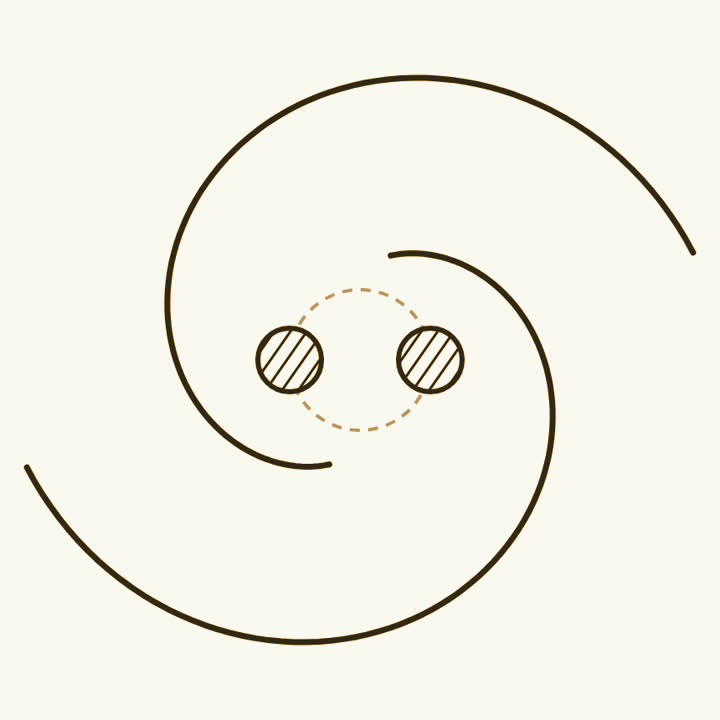
When heavy things swing around each other, space itself ripples.
Albert Einstein predicted it in 1916. Masses whirling round each other send out waves that stretch and squeeze space as they pass. The waves travel at the speed of light. But even from the most violent events in the universe, they are unimaginably faint by the time they reach us. Einstein doubted anyone would ever detect them.
In 1974 astronomers found two dead stars in an orbit that turned out to be shrinking.
Russell Hulse and Joseph Taylor found a pulsar, a spinning neutron star, locked in a tight orbit with another neutron star. Over the years its timing showed the orbit getting smaller, by about three and a half metres a year. That was exactly the energy Einstein’s theory said the pair should lose as gravitational waves. Hulse and Taylor won the Nobel Prize in 1993.
On 14 September 2015 a ripple from two colliding black holes reached the Earth.
It had been travelling for about 1.3 billion years. The black holes were about 36 and 29 times the mass of the Sun, and they spiralled together and merged. In a fraction of a second, about three Suns’ worth of mass turned into gravitational waves. For that instant, the collision gave off more power than all the stars in the observable universe combined.
LIGO caught it with detectors shaped like a giant L, each arm 4 kilometres long.
A laser beam is split and sent down both arms, bounced off mirrors and brought back together. A passing wave stretches one arm and squeezes the other, so the two beams no longer match. The change in length was about a thousandth of the width of a proton. It is one of the most delicate measurements ever made.
Two detectors 3,000 kilometres apart felt it seven milliseconds apart.
One is in Livingston, Louisiana, the other in Hanford, Washington. Trucks and earthquakes shake one detector at a time. A real wave passes through both. Both recorded the same pattern, growing faster and stronger as the black holes spiralled in, then stopping. Turned into sound, it is a short rising chirp. Three of LIGO’s leading scientists won the Nobel Prize in 2017.
In 2017 the ripples from two colliding neutron stars arrived with a flash of light.
Gamma rays from the same collision reached the Earth 1.7 seconds after the gravitational waves, after a journey of about 130 million years. So gravity’s ripples travel at the speed of light, to within a few parts in a million billion. Telescopes then found the glow of the collision, and in it the signs of heavy elements such as gold being made. Some of the gold on the Earth was probably forged this way.
So when you look up at the night sky, ask what you cannot see.
Gravitational wave detectors have now heard hundreds of collisions, most of them between black holes that give off no light at all. Each signal travelled through space for millions or billions of years to reach us. A European mission called LISA plans to fly three spacecraft millions of kilometres apart, to catch much bigger, slower ripples. The universe was never silent. We just could not hear it.
Sources
- First observation of gravitational waves, Wikipedia. The 2015 black hole collision, how LIGO caught it, and how the team made sure it was real.
- Hulse–Taylor binary, Wikipedia. The pair of neutron stars whose shrinking orbit gave the first evidence of gravitational waves.
- GW170817, Wikipedia. The neutron star collision seen in both gravitational waves and light, and what it revealed about gold and the speed of gravity.
Nearby ideas
- Gravity bends light. Why starlight bends around the Sun, and how a 1919 eclipse proved it.
- The constant speed of light. Why light is measured at the same speed by everyone, however they move.
- Where not even light escapes. Why some stars collapse into places light cannot leave, and how we found them.
- Moving clocks run slow. Why moving clocks run slow, and how muons and airliners proved it.
- Mass and energy are the same thing. Why mass and energy are the same thing, and why a gram holds so much.
- Falling feels like floating. Why falling feels like floating, and how that led Einstein to gravity.
- Gravity slows time. Why clocks run slower in stronger gravity, and why GPS has to allow for it.