Cobra Effect · Thinking and evidence
The decoy effect
A worse option added to a menu can steer what you choose.
6 cards, read aloud in 2:11, with a test and sources.
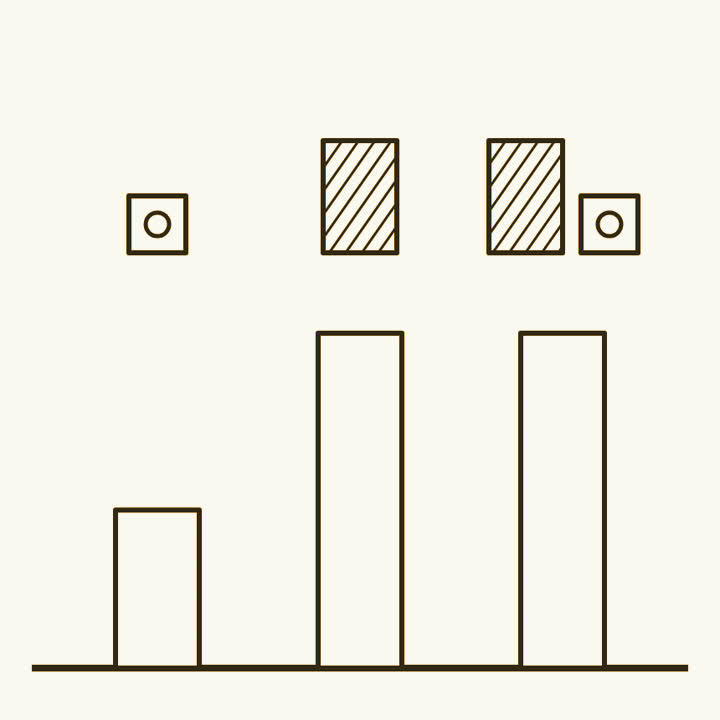
A magazine offers you three subscriptions. One of them is absurd.
Web only, $59. Print only, $125. Print and web together, $125. Read that again. The middle one costs the same as the one that contains it.
Nobody picks the middle one. That is not what it is for.
Dan Ariely put this choice to a hundred students and wrote it up in 2008. Not one of them chose print only. Most took print and web together. The rest took the cheap web option.
Then he took the useless option away and ran it again.
Same two real choices, same prices on both. This time most students took the cheap web only deal. Print and web fell from the favourite to the minority. The option that nobody wanted had been doing all the work.
Researchers had shown this in the journals back in 1982.
Huber, Payne and Puto published it in the Journal of Consumer Research. Add a third option that is clearly worse than one of the other two, and choices swing towards the one that beats it. The decoy is not there to be chosen. It is there to make its neighbour look generous.
It is real, and it is smaller than the classroom version.
You rarely know what a thing is worth on its own, so you compare it with whatever is sitting beside it. Later studies find the pull is genuine but modest, and it can fade with familiar products and real money. Whoever chooses what sits beside a thing is choosing your comparison for you.
So look for the option that exists in order to lose.
Three tiers, and the middle one makes no sense? It was never meant for you. Cover the odd one with your thumb and ask what you would pick from what is left. Then ask what the thing is worth to you in money, with nothing standing next to it.
Sources
- Decoy effect, Wikipedia. The mechanism, the subscription example, and the 1982 paper by Huber, Payne and Puto that first showed it. Search that page for asymmetric dominance.
- Predictably Irrational, Dan Ariely, 2008. The subscription demonstration is in the opening chapters, with a run of other experiments on how people value things by comparison.
- Nudge, Richard Thaler and Cass Sunstein, 2008. On how the arrangement of choices shapes what gets chosen, and what follows from the fact that somebody always has to arrange them.
Nearby ideas
- The framing effect. The same facts, worded differently, lead to different choices.
- Anchoring. The first number you hear bends every estimate that follows.
- Loss aversion. Losing something hurts about twice as much as gaining it pleases.
- The endowment effect. We value things more simply because they are ours.
- Inattentional blindness. Focus hard enough and you miss what is right in front of you.
- Post hoc ergo propter hoc. Coming first does not mean causing what came after.
- Correlation is not causation. Two things moving together may share a hidden cause.
- Steelmanning. Argue against the strongest version of a view, not the weakest.