Cobra Effect · Science and philosophy
The experience machine
Would you trade real life for guaranteed happy feelings?
7 cards, read aloud in 2:29, with a test and sources.
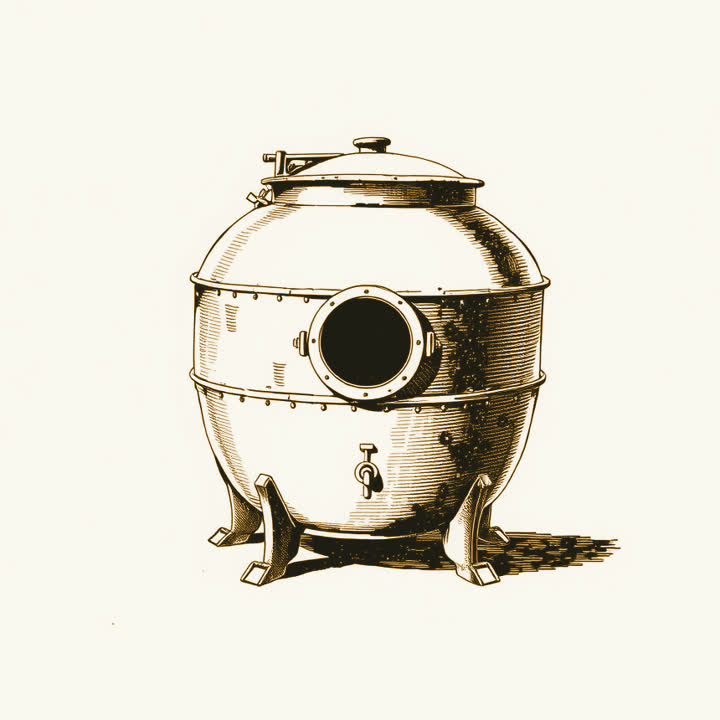
A machine can give you any experience you want. Would you plug in?
Any life at all. Writing the novel. Winning the race. Being loved. It would feel exactly like the real thing, because feeling is all it does. And you would not know you were in the tank.
Robert Nozick asked the question in 1974.
It sits in a book of political philosophy called Anarchy, State, and Utopia. He was arguing with a simple idea. That what matters in the end is only how a life feels. If that were true, plugging in would be an easy yes.
Most people say no. That is the interesting part.
Ask a room and watch. People flinch. They cannot always say why, and most of them refuse anyway. Which means that how a life feels is not the only thing they wanted from it.
Nozick gave three reasons for the flinch.
We want to do things, not merely to have the experience of doing them. We want to be a certain kind of person, and a body floating in a tank is not any kind of person. And we want contact with something we did not make up.
One later experiment complicates the story.
Felipe De Brigard, in 2010, told people they were already in the machine and offered to unplug them. Many of them refused that too. So some of the flinch is a preference for whatever you already have, rather than a pure love of the real.
The tank is a test, not a prediction.
You do not have to believe such a machine could ever be built. The question is only what your refusal reveals about what you were really after. Most people find they wanted the doing, and the being, and the truth of it. The good feeling was a sign of those things, not a replacement for them.
You meet a small version of this most weeks.
The flattering report you know is not accurate. The conversation you rehearse instead of having. Anything that hands you the feeling of a thing without the thing. So ask, of whatever you are chasing, would I still want this if nobody could ever know, and none of it were true? Your answer is your real goal.
Sources
- Experience machine, Wikipedia. The thought experiment, the three reasons Nozick gave for refusing, and the later objections including the finding that people also refuse to unplug.
- Anarchy, State, and Utopia, Robert Nozick, 1974. The machine takes up about three pages of a long and argumentative book about the state. Those three pages are the ones everybody remembers.
- Hedonism, Stanford Encyclopedia of Philosophy. The idea the machine was built to test. That pleasure and the absence of pain are the only things good in themselves, and what believing that commits you to.
Nearby ideas
- The trolley problem. Why harm that follows from a plan feels different from harm that is the plan.
- The veil of ignorance. Write the rules as if you did not know which seat you would get.
- What you measure is what you get. Why the number you chase quietly replaces the thing you wanted.
- The nirvana fallacy. Rejecting a good plan for not being perfect keeps a worse one.
- Falsifiability. A claim that nothing could disprove tells you nothing.
- The problem of induction. A long run of past successes cannot prove the next one.
- The ship of Theseus. Replace every part, and ask whether it is still the same thing.
- The placebo effect. Much of what a dummy pill seems to do would have happened anyway.