Cobra Effect · Incentives and systems
Second order effects
Every fix has consequences, and those have consequences too.
5 cards, read aloud in 1:35, with a test and sources.
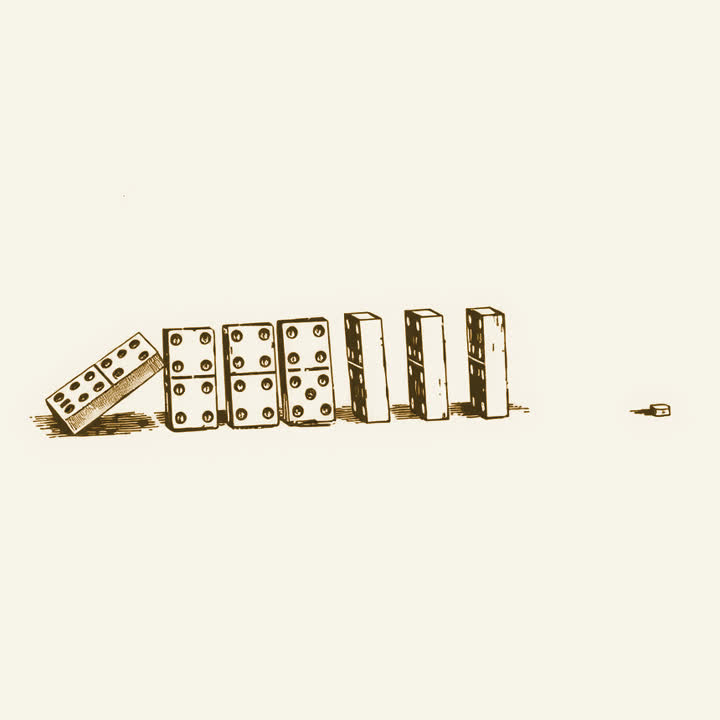
Every decision has a consequence. Then the consequence has one.
First order thinking asks what happens next. Second order thinking asks, and then what? Most bad decisions were good at the first order.
Lower the price and sales go up.
That is the first order. Then customers learn to wait for the sale. Full price stops selling. The discount that lifted one quarter lowered every quarter after it.
A city pays a bounty for every dead cobra.
First order: dead cobras arrive, and the streets are safer. Second order: people start breeding cobras, because a cobra is now worth money. Third order: the bounty is cancelled, the breeders release their stock, and the city has more cobras than before. The story is probably a legend. The pattern is not.
It is hard because the first order is visible and the second is not yet.
The benefit arrives now. The cost arrives later, somewhere else, to someone who may not connect it to you. Systems remember what you did to them.
The practice is a single question, asked twice.
And then what? And then what? Write the answers down before you decide. If the second answer is worse than the first is good, you have your decision.
Sources
- The Unanticipated Consequences of Purposive Social Action, Robert K. Merton, 1936. The sociologist who first sorted out why well meant actions misfire: ignorance, error, short term interest, and the way a prediction changes the thing predicted. The Wikipedia article summarises it and gives the citation.
- Thinking in Systems, Donella Meadows, 2008. The gentlest introduction to feedback loops, delays and why the second order arrives later and somewhere else. Short, and every chapter has a diagram you can redraw on a napkin.
- Parable of the broken window, Wikipedia. Frédéric Bastiat’s 1850 essay on what is seen and what is not seen, the original argument that the visible first order hides the invisible second. Ten minutes, and it still reads well.
Nearby ideas
- The Cobra effect. Why paying for a result can breed more of the problem.
- Chesterton’s fence. Before removing a rule, find out why it was put there.
- The sunk cost fallacy. Money already spent is gone, so it should not steer the next choice.
- The tragedy of the commons. Why shared things get used up, and how communities stop it.
- Moral hazard. Shield people from a risk and they take more of it.
- The Jevons paradox. Why making something efficient can make us use more of it.
- Braess’s paradox. Why adding a road can make everyone’s journey slower.
- Path dependence. Why early choices stay locked in long after better ones appear.