Cobra Effect · Incentives and systems
The tragedy of the commons
Why shared things get used up, and how communities stop it.
7 cards, read aloud in 2:60, with a test and sources.
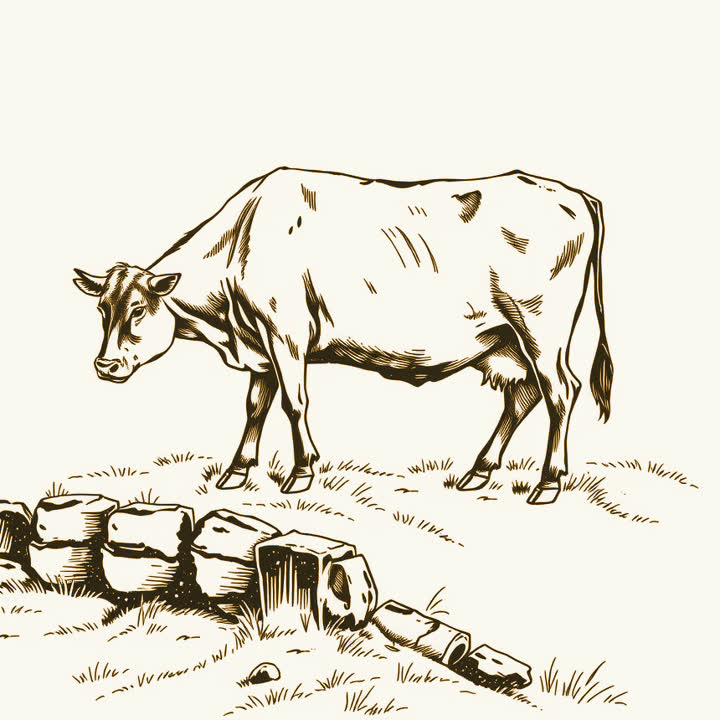
A village has a pasture. Anyone may graze cattle on it.
Each herdsman asks himself a simple question. What happens if I add one more cow? He gets the whole of the extra milk. The extra grazing is shared by everyone. So he adds the cow.
Every herdsman does the same sum, and gets the same answer.
Each new cow is a clear win for its owner and a small loss for the whole village. Nobody is greedy. Nobody is stupid. And the pasture is eaten down to the dirt.
Garrett Hardin called it the tragedy of the commons in 1968.
He borrowed the pasture from a pamphlet by William Forster Lloyd, written in 1833. A commons is any shared resource that nobody owns and anyone can use. Fish in the sea. Clean air. The office fridge. Hardin’s conclusion was bleak. Freedom in a commons, he wrote, brings ruin to all.
The oceans proved him right. Then a political scientist showed he was only half right.
In 1992 Canada closed the Newfoundland cod fishery. Five centuries of fishing, and the cod were gone. But Elinor Ostrom had spent years visiting commons that had not collapsed. Alpine pastures in Switzerland, grazed under the same village rules for hundreds of years. Irrigation canals in Spain, with a water court in Valencia that has met for about a thousand years.
Ostrom found the pattern. Communities can manage a commons, if they are allowed to.
The ones that lasted had clear boundaries, so everyone knew who was in. Rules made by the users themselves, not handed down from a distant capital. Monitoring, done by people who were also users. And punishments that started small and grew. In 2009 she became the first woman to win the Nobel prize in economics.
So the tragedy is not a law of nature. It is a design failure.
Hardin saw two answers. Sell the pasture off, or let the state fence it. Ostrom found a third. Let the people who use it write the rules and watch each other keep them. What kills a commons is not sharing. It is sharing with strangers, with no rules, and nobody counting.
Look at whatever you share and ask three questions.
Who is allowed in? Who made the rules, and can they change them? Who notices when someone cheats, and what happens then? If the answers are everyone, nobody and nothing, the pasture is already going.
Sources
- Tragedy of the commons, Wikipedia. Hardin’s 1968 essay in Science, Lloyd’s 1833 pamphlet, the criticisms, and Ostrom’s reply. The essay itself is short and worth searching for by name.
- Governing the Commons, Elinor Ostrom, 1990. The field work. Swiss pastures, Japanese forests, Spanish and Philippine irrigation, and the eight design principles that the surviving commons shared.
- Elinor Ostrom, Wikipedia. Her life, the 2009 Nobel prize, and a plain summary of the design principles for anyone who does not want the whole book.
Nearby ideas
- Second order effects. Every fix has consequences, and those have consequences too.
- Moral hazard. Shield people from a risk and they take more of it.
- The bystander effect. The more people who see a problem, the less each one acts.
- The Jevons paradox. Why making something efficient can make us use more of it.
- Braess’s paradox. Why adding a road can make everyone’s journey slower.
- Path dependence. Why early choices stay locked in long after better ones appear.
- The Lindy effect. The longer an idea has lasted, the longer it is likely to last.
- Antifragility. Some things get stronger from knocks, and fail without them.