Cobra Effect · Light and electricity
A moving magnet makes electricity
How a swinging compass needle led, in eleven years, to the first generator.
7 cards, read aloud in 3:35, with a test and sources.
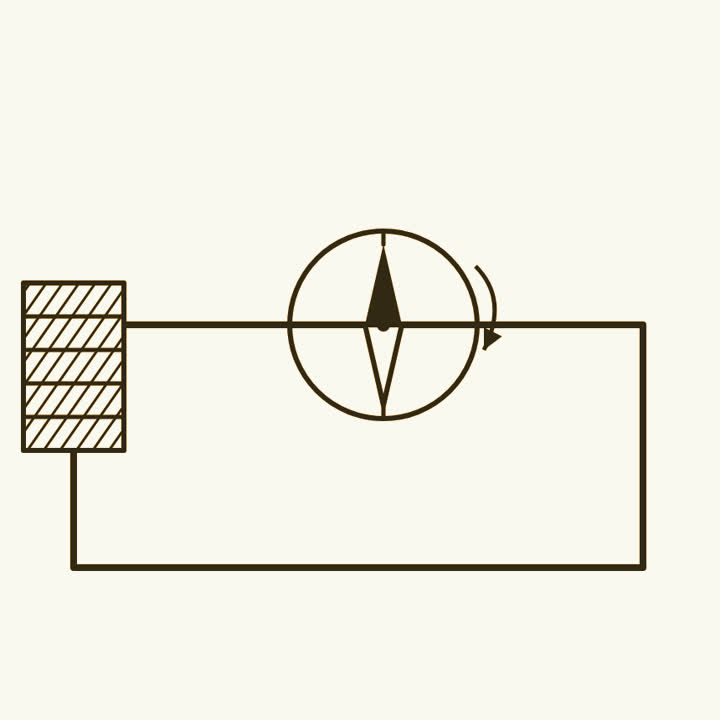
In 1820 Hans Christian Oersted saw a compass needle swing beside a wire carrying a current.
Oersted, a professor in Copenhagen, had been looking for a link between electricity and magnetism for some time. When a current flowed through a wire above a compass, the needle turned away from north. When the current stopped, the needle swung back. In July 1820 he announced it in a four page paper in Latin, and it was soon translated across Europe.
The needle did not point along the wire, or towards it, but around it.
Small compasses set in a ring around a wire carrying a current all line up in a circle. Reverse the current, and every needle turns to face the other way round. A current in a wire is wrapped in a magnetic push that circles it. That circling is why the needle swings sideways, instead of being pulled towards the wire.
Within weeks, in Paris, Andre-Marie Ampere showed that two wires pull on each other.
Oersted’s result was demonstrated to the Academy of Sciences in Paris early in September 1820. By the end of that month, Ampere had shown that two parallel wires attract each other when their currents flow the same way. When the currents flow opposite ways, the wires push apart. No magnets were needed at all. Electric currents alone were acting like magnets.
In 1821 Michael Faraday made a wire spin round a magnet.
He stood a magnet upright in a bowl of mercury, and hung a wire so that its lower end dipped into the mercury. When a current ran through the wire, the wire swept round and round the magnet, for as long as the current flowed. Electricity and magnetism together were making continuous motion. It was the principle behind the electric motor.
For years, people looked for the reverse: electricity made by magnetism.
In August 1831 Faraday wound two coils of wire on opposite sides of an iron ring. He joined one coil to a battery, and the other to a meter. While the current flowed steadily, the meter showed nothing. But at the moment he switched the current on or off, the needle kicked. It was not magnetism that made a current, but a change in magnetism.
Then he made a current with nothing but a moving magnet.
That autumn he pushed a bar magnet into a coil of wire joined to a meter, and the needle jumped. Pulling the magnet out made it jump the other way. Holding it still did nothing. In October 1831 he turned a copper disc between the poles of a magnet, and got a steady current for as long as it turned. It was the first electric generator.
So when you switch on a light, ask what is turning somewhere to make it.
Most of the world’s electricity is still made by Faraday’s principle, with magnets and coils turning past each other in generators. Steam, falling water or the wind does the turning. Solar panels are one of the few big exceptions. The motor in a fan uses the same connection the other way round. A swinging needle in 1820 led, in eleven years, to the first generator.
Sources
- July 1820: Oersted and electromagnetism, APS News. How a compass needle beside a wire started the study of electromagnetism.
- September 4, 1821 and August 29, 1831: Faraday and electromagnetism, APS News. The wire that spun round a magnet in 1821, and the iron ring of 1831.
- The birth of the electric machines, Philosophical Transactions A, 2015. A commentary on Faraday’s 1832 paper on induction and the first generator.
Nearby ideas
- A frog’s twitch led to the first battery. How an argument over twitching frogs’ legs gave the world its first battery.
- Lightning is a giant spark. How a thread, a jar and an iron rod showed that lightning is electricity.
- Light is a wave of electricity and magnetism. How equations predicted invisible waves, and sparks across a room proved them real.
- Why the sky is blue. How a hazy glass tube and a calculation explained the colour of the sky.
- White light is every colour at once. How a second prism showed the colours were in sunlight all along.
- There is light on both sides of the rainbow. How thermometers, silver salts and a glowing screen found light we cannot see.
- Light takes time to arrive. How a moon of Jupiter and a spinning wheel showed that light takes time to arrive.