Cobra Effect · Light and electricity
A frog’s twitch led to the first battery
How an argument over twitching frogs’ legs gave the world its first battery.
7 cards, read aloud in 3:50, with a test and sources.
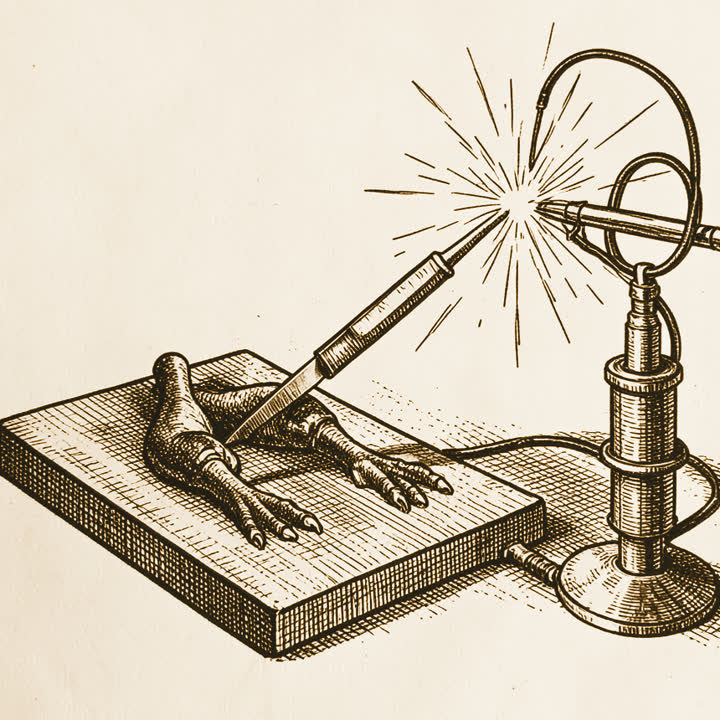
In the 1780s Luigi Galvani saw a dead frog’s leg kick.
Galvani, a doctor in Bologna, was studying nerves and muscles, using frogs’ legs with the nerves laid bare. When a scalpel touched a nerve while an electrical machine was running, the leg kicked as if it were alive. Muscles, it seemed, could be moved by electricity. He spent years working out when the twitching happened, and why.
Then the legs twitched with no machine at all, just from touching metals.
He pressed a copper hook into a frog’s spinal cord, and hung the hook on an iron railing. The legs twitched during storms. But they also twitched with no storm and no machine, through the metals alone. Galvani concluded that the electricity came from the animal itself, and called it animal electricity. Electric fish such as the torpedo ray were already known to give shocks. He published his results in 1791.
Alessandro Volta suspected the electricity came from the metals, not the frog.
Volta, a professor at Pavia, repeated Galvani’s experiments and grew doubtful. He argued that the charge was made where two different metals met, such as the steel of a scalpel and the brass of a hook. In his view, the frog’s leg was only a very sensitive detector of that electricity. The quarrel between the two sides went on for years.
To prove his point, in 1800 Volta built a pile of metal discs.
He stacked pairs of zinc and copper or silver discs, with cloth or card soaked in salty water between each pair. With no animal anywhere, the pile gave out electricity, and each pair added to the push. Unlike a Leyden jar, which empties in one spark, the pile kept a current flowing. He described it in March 1800, in a letter to Joseph Banks, president of the Royal Society in London.
Volta called his pile an artificial electric organ, after the torpedo ray.
The torpedo gives its shocks from organs made of many stacked layers, and Volta’s pile copied that stacked build. In May 1800, before Volta’s letter was even published, William Nicholson and Anthony Carlisle used a pile to split water into hydrogen and oxygen. In 1801 Volta showed his pile to Napoleon in Paris. And in 1807 Humphry Davy used electricity from batteries to isolate two new metals, potassium and sodium.
In the end, both men were partly right.
Volta was right that different metals with something damp between them make electricity. Batteries still work that way. Galvani was right that nerves and muscles run on electricity. But there is no special animal electricity, and Volta was wrong to think the metals explained every twitch. Galvani died in 1798, before the pile was built. The volt, the unit of electrical push, is named after Volta.
So when two people argue over the same thing they saw, ask what each of them might be getting right.
Galvani and Volta watched the same twitching legs and drew opposite conclusions. Trying to prove himself right, Volta built something new: a steady source of electricity. That steady current opened the way to splitting compounds, to electromagnets, and to much of what followed. The argument proved more useful than either side winning it.
Sources
- Voltaic pile, Wikipedia. How Volta’s stack of discs worked, his letter of 1800, and what it made possible.
- The first battery: dead frogs sparked the voltaic pile, IEEE Spectrum. The quarrel between Galvani and Volta, and how the pile came out of it.
- Frogs and animal electricity, Whipple Museum of the History of Science. Galvani’s prepared frogs, his experiments, and the animal electricity he believed in.
Nearby ideas
- Lightning is a giant spark. How a thread, a jar and an iron rod showed that lightning is electricity.
- A moving magnet makes electricity. How a swinging compass needle led, in eleven years, to the first generator.
- Light is a wave of electricity and magnetism. How equations predicted invisible waves, and sparks across a room proved them real.
- Why the sky is blue. How a hazy glass tube and a calculation explained the colour of the sky.
- White light is every colour at once. How a second prism showed the colours were in sunlight all along.
- There is light on both sides of the rainbow. How thermometers, silver salts and a glowing screen found light we cannot see.
- Light takes time to arrive. How a moon of Jupiter and a spinning wheel showed that light takes time to arrive.