Cobra Effect · Light and electricity
White light is every colour at once
How a second prism showed the colours were in sunlight all along.
7 cards, read aloud in 3:35, with a test and sources.
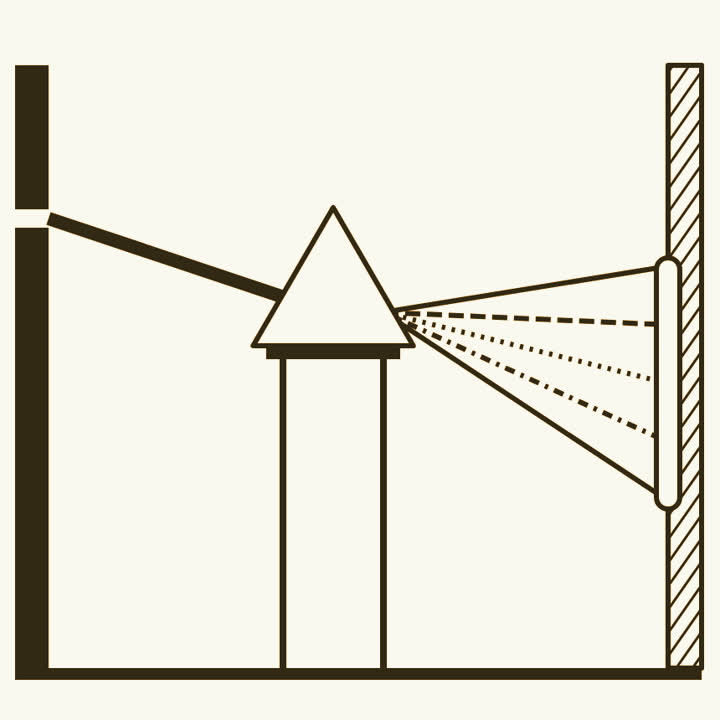
In 1666 a young Isaac Newton let a thin beam of sunlight into a dark room and through a glass prism.
He made a small round hole in his window shutter, and set the prism in the beam. On the far wall the light spread into a band of colours, red at one end and violet at the other. Prisms were well known, and so were their colours. What puzzled Newton was the shape. The patch was about five times longer than it was wide, though the hole was round.
Almost everyone thought the prism added the colours to the light.
From Aristotle to Descartes, white light was taken to be pure and simple. Colours, on that view, were changes that glass or water made to it. Newton wondered whether the colours had been in the sunlight all along, and the prism only spread them apart. To tell the two ideas apart, he needed an experiment that only one of them could survive.
He let just one colour through a second prism, and it stayed exactly that colour.
He let the band of colours fall on a board with a small hole in it, so only one colour got through. That colour then passed through a second prism. If glass made colours, the second prism should have changed it again. It did not. Red stayed red, and violet stayed violet. Newton called it his experimentum crucis, the crucial experiment.
Each colour bent by its own fixed amount.
At the second prism, violet light bent more than red light, just as it had at the first. So white sunlight is a mixture of colours, and glass bends each of them by a different amount. That is why the patch on the wall was long: each colour landed in a slightly different place. A prism does not make colours. It sorts them.
Newton first counted five colours in the spectrum, and later seven.
In his lectures at Cambridge around 1670 he named five main colours. By the time he published his book Opticks, in 1704, there were seven, with orange and indigo added. Historians think he settled on seven partly to match the seven notes of the musical scale. The spectrum itself has no borders. The number of colours is a choice about where to draw the lines.
The discovery also convinced him that telescope lenses could never be cured of colour.
A lens is curved glass, so it spreads colours too, leaving blurred coloured fringes around stars. Newton decided the problem could not be fixed, and in 1668 he built a telescope that gathered light with a curved mirror instead. A mirror reflects every colour the same way, so the fringes vanished. He was wrong about lenses. Later opticians cancelled the fringes by pairing two kinds of glass.
So when something seems to add something new, ask whether it is only sorting what was there.
Before Newton, the prism looked like a maker of colours. His second prism showed that the colours were in the sunlight all along. When his paper appeared in 1672, Robert Hooke argued that the experiments did not prove it, and the two quarrelled for years. Newton had the better experiment: one that only one idea could survive.
Sources
- A Letter Containing His New Theory about Light and Colours, Isaac Newton, 1672 (The Newton Project). Newton’s own account of the darkened room, the long spectrum and the crucial experiment.
- Newton shows the light, Philosophical Transactions A, 2015. A modern commentary on Newton’s 1672 paper, the quarrel with Hooke, and why it mattered.
- Newtonian telescope, Wikipedia. Why Newton turned to a mirror in 1668, and how later opticians fixed the colours in lenses.
Nearby ideas
- Atomic spectra and energy levels. Why each element glows in its own few colours, like a fingerprint.
- The constant speed of light. Why light is measured at the same speed by everyone, however they move.
- There is light on both sides of the rainbow. How thermometers, silver salts and a glowing screen found light we cannot see.
- Light takes time to arrive. How a moon of Jupiter and a spinning wheel showed that light takes time to arrive.
- Lightning is a giant spark. How a thread, a jar and an iron rod showed that lightning is electricity.
- A frog’s twitch led to the first battery. How an argument over twitching frogs’ legs gave the world its first battery.
- A moving magnet makes electricity. How a swinging compass needle led, in eleven years, to the first generator.
- Light is a wave of electricity and magnetism. How equations predicted invisible waves, and sparks across a room proved them real.