Cobra Effect · Light and electricity
Lightning is a giant spark
How a thread, a jar and an iron rod showed that lightning is electricity.
7 cards, read aloud in 3:38, with a test and sources.
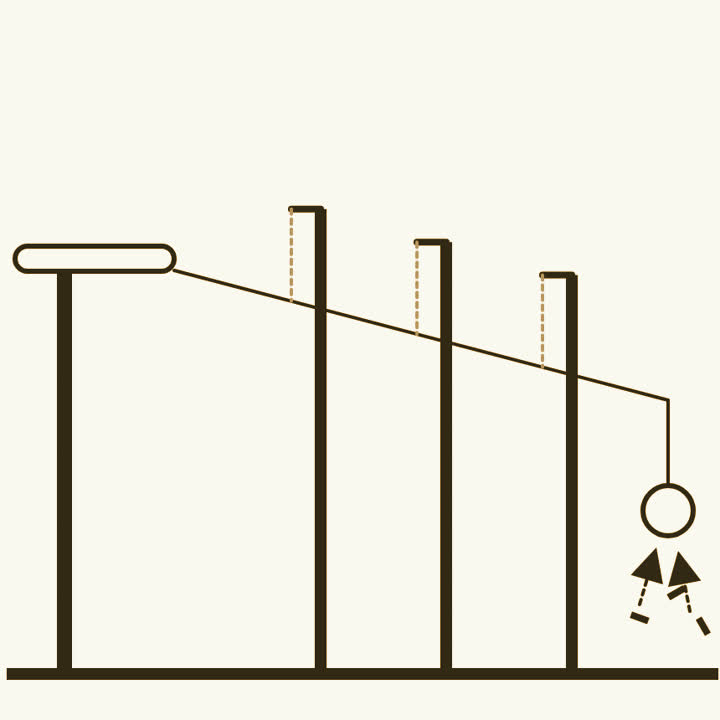
In 1729 Stephen Gray sent electricity along a thread, out across a field.
He rubbed a glass tube until it would pull on scraps of chaff, then tied a long thread to it. At the far end of the thread hung a small ivory ball, and the ball began to lift chaff too. With his friend Granville Wheler, he stretched the thread to about eight hundred feet, across a paddock in Kent. Electricity was not stuck where it was made. It could travel.
It only worked when the thread hung from silk, not from wire.
When they held the thread up with wire, the electricity leaked away. With silk, it reached the far end. They first put it down to the thickness of the supports, before seeing that silk itself let far less through. Some materials carry electricity easily, and others hold it back. We still call them conductors and insulators.
Gray even hung a boy on silk cords and electrified him.
The boy was held up in the air, lying on cords of silk. Gray brought a rubbed tube near the boy’s feet, without touching him. Scraps of paper and chaff leapt up to the boy’s face and hands. His body carried the electricity, and the silk kept it from draining away.
In 1733 Charles du Fay found that electricity comes in two kinds.
Things charged the same way push each other apart. But a thing charged from rubbed glass and a thing charged from rubbed resin pull together. Du Fay called the two kinds vitreous and resinous, after glass and resin. Later, Benjamin Franklin called them positive and negative, the names we still use.
In 1745, electricity was stored in a jar for the first time, and it bit back.
Ewald von Kleist in Germany, and a group at Leiden in the Netherlands, each found a way to charge a glass jar. Holding the jar while touching the wire that ran into it gave a violent shock. Pieter van Musschenbroek wrote that he would not go through it again for all the kingdom of France. Named the Leyden jar, it let people store up a charge and release it all at once.
In 1752 a spark drawn from a thundercloud showed that lightning is electricity.
In 1750 Franklin proposed a test: a tall, pointed iron rod set up high, to draw electricity from a storm cloud. In France, Thomas-Francois Dalibard built one. In May 1752, as a storm passed over, a retired soldier drew sparks from it. Franklin later reported flying a kite in a storm that year, and drawing a spark from a key on its string. Historians are less sure of the kite than of the rod, because Franklin wrote so little about it at the time.
So when something seems too big to study, ask whether it is a small thing you already know.
Lightning seemed beyond explaining. It turned out to be the same kind of spark that jumps from a charged jar. Franklin put that knowledge to work in the lightning rod. A pointed metal rod on a roof, joined by a conductor to the ground, gives a strike an easy path that bypasses the building. A spark in a jar and a bolt from the sky follow the same rules.
Sources
- Stephen Gray (scientist), Wikipedia. The thread across the paddock, silk against wire, and the boy on silk cords.
- Leyden jar, Wikipedia. How von Kleist and the Leiden group stored electricity, and the shock that followed.
- Report of an experiment with lightning, 13 May 1752, Thomas-Francois Dalibard (Founders Online). Dalibard’s own account of the iron rod at Marly and the sparks drawn from a storm.
Nearby ideas
- A frog’s twitch led to the first battery. How an argument over twitching frogs’ legs gave the world its first battery.
- A moving magnet makes electricity. How a swinging compass needle led, in eleven years, to the first generator.
- Light is a wave of electricity and magnetism. How equations predicted invisible waves, and sparks across a room proved them real.
- Why the sky is blue. How a hazy glass tube and a calculation explained the colour of the sky.
- White light is every colour at once. How a second prism showed the colours were in sunlight all along.
- There is light on both sides of the rainbow. How thermometers, silver salts and a glowing screen found light we cannot see.
- Light takes time to arrive. How a moon of Jupiter and a spinning wheel showed that light takes time to arrive.