Cobra Effect · Quantum mechanics
Decoherence
Why big things never show two states at once.
7 cards, read aloud in 3:12, with a test and sources.
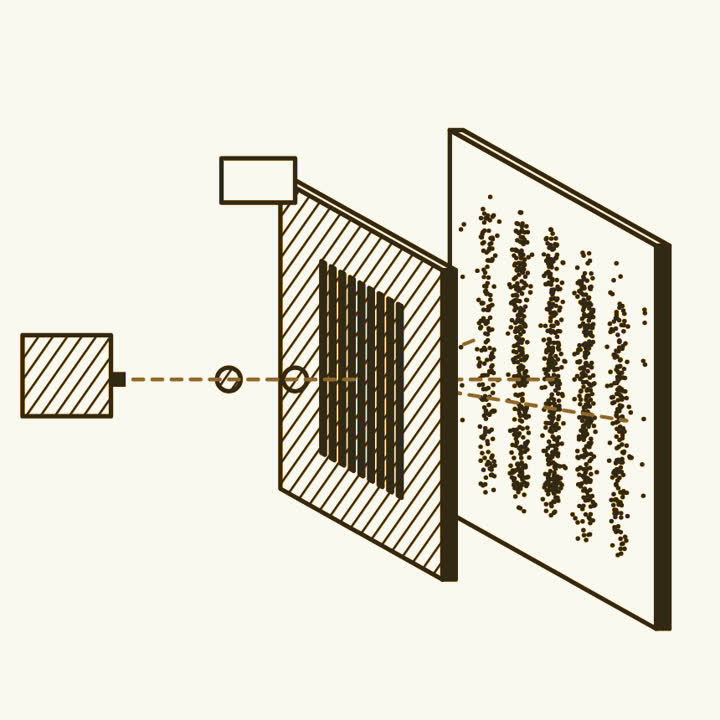
Molecules of 70 carbon atoms can travel as waves.
These are a little bigger than the 60 atom molecules of 1999. Sent one at a time through fine gratings in a vacuum, they build up bands too. The bands mean each molecule’s wave passed through many slits at once. In 2004 a team in Vienna tried heating the molecules on the way. The hotter the molecules, the fainter the bands.
Heat them enough, and the bands disappear.
A hot molecule gives off tiny flashes of light as it flies. Each flash carries away a trace of where the molecule was. Nobody reads those flashes. They simply leave, out into the vacuum. That is enough. With a record of the path out there, the wave no longer adds up and cancels.
That is decoherence.
A quantum object in two states at once leaks traces of itself into its surroundings. Stray light, air molecules, heat. Each bump carries a little record away. Once the surroundings hold a record, the two states stop interfering. Hans Dieter Zeh began working this out in 1970, and Wojciech Zurek and Erich Joos carried it on.
Big things decohere almost instantly.
A speck of dust in air is struck by countless air molecules and particles of light every second. Any spread in where it is gets recorded, and destroyed, far faster than anything could measure. That is why tables and cats are never seen in two places. The quantum rules still apply to them. The evidence just drains away at once.
In 1996 physicists watched it happen, step by step.
Serge Haroche’s team in Paris trapped a little light between two mirrors. They put the light into two states at once, then sent atoms through it to probe it. They saw the two states stop interfering, and faster the further apart the states were. Haroche shared the Nobel Prize for this kind of work in 2012.
It is the enemy of every quantum computer.
A quantum computer works by keeping many states in play at once. Every stray bump from its surroundings wears that away. So its parts are cooled close to absolute zero and shielded from light, heat and vibration. The race to build one is largely a race against decoherence.
So when you hear that a measurement needs a watcher, ask what the surroundings already know.
Decoherence needs no mind. Stray light and air molecules are enough. It explains why the bands vanish, and why big things never show two states at once. On its own, it does not settle why one particular result happens rather than another. Physicists still argue about that part. The fading of the bands is measured.
Sources
- Controlling photons in a box and exploring the quantum to classical boundary, Serge Haroche, Nobel lecture, 2012. Haroche on trapping light between mirrors, putting it into two states at once, and watching those states decohere.
- Particle control in a quantum world, The Nobel Prize in Physics 2012, popular information. A plain account of how Haroche and David Wineland held single quantum systems still long enough to watch their quantum states fade.
- Quantum decoherence, Wikipedia. How surroundings carry away records of a quantum state, how fast it happens for big things, and what it does and does not explain about measurement.
Nearby ideas
- Superposition and the double slit. One electron at a time, and still a pattern only waves should make.
- Entanglement and Bell’s test. Why two distant particles share results no advance plan can explain.
- A photon is a ripple in a field. What a photon actually is: the field itself, raised by one whole step.
- The photoelectric effect. The experiment that showed light arrives in packets, not only as waves.
- Atomic spectra and energy levels. Why each element glows in its own few colours, like a fingerprint.
- The uncertainty principle. Why pinning down where a particle is spreads out where it is going.
- Spin, and the magnet that split a beam. The magnet experiment that showed atoms answer in just two ways.
- Quantum tunnelling. How particles slip through walls they lack the energy to climb.