Cobra Effect · Quantum mechanics
The uncertainty principle
Why pinning down where a particle is spreads out where it is going.
7 cards, read aloud in 3:02, with a test and sources.
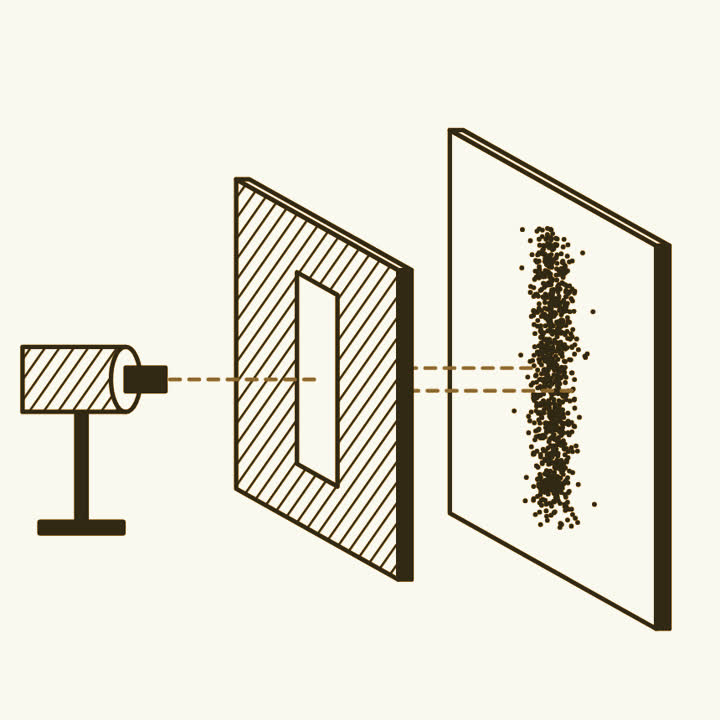
Shine a beam through a single slit, and it lands as a stripe on the wall.
A wide slit gives a stripe about as wide as the slit. Almost everything goes straight on, the way you would expect. Now close the slit down, to pin down exactly where the beam crosses. The stripe ought to get narrower.
It gets wider instead.
The narrower the slit, the more the beam fans out beyond it. Pin down where it crosses, and you lose track of where it is heading. Electrons do exactly the same thing. Claus Jönsson sent electrons through tiny slits in 1961 and watched them spread.
In 1927 Werner Heisenberg turned that into a rule.
A particle cannot have a sharp position and a sharp momentum at the same time. Momentum is how much a thing is moving, and in which direction. Squeeze the spread in one, and the spread in the other grows. Earle Kennard proved the exact limit that same year. The two spreads, multiplied together, never fall below a fixed and very tiny amount.
Heisenberg first explained it with a microscope, and got the reason slightly wrong.
To see an electron, you have to bounce light off it. The light gives it a kick, he said, so finding where it is spoils how it moves. Niels Bohr objected, and Heisenberg added a note to the paper before it was printed. The spread is not just clumsy measuring. It is built into the particle’s own state.
It is also part of why atoms do not collapse.
The nucleus pulls the electron inward. But the more tightly the electron is confined, the wider the spread in its momentum, and the more energy that costs. Somewhere, the pull and the spread balance. A rough version of that sum gives hydrogen a size of about a tenth of a billionth of a metre, close to the real thing.
Helium will not freeze, however cold you make it.
Cool it to within a whisker of absolute zero at ordinary pressure, and it stays a liquid. Its atoms are light, and they cling to each other only weakly. A leftover jiggle that no cooling can remove keeps them from locking into place. Squeeze it to about 25 times normal air pressure, and at last it turns solid.
So when you hear that looking changes things, ask what is really being claimed.
The limit is not about people watching, or about poor instruments. It is a trade built into how small things exist. The more sharply one is fixed, the more the other spreads. It is not a licence for vagueness either. The limit is exact, and it can be calculated.
Sources
- The development of quantum mechanics, Werner Heisenberg, Nobel lecture, 1933. Heisenberg’s own account of how the new mechanics was built, including why position and momentum cannot both be known exactly.
- The Relation of Wave and Particle Viewpoints, Richard Feynman, The Feynman Lectures on Physics, Volume III, 1965. The second chapter works through the single slit and shows how the narrowing of the slit and the spreading of the beam fit the limit.
- Uncertainty principle, Wikipedia. Heisenberg’s 1927 paper, Kennard’s exact limit, the microscope argument and Bohr’s objection, and the difference between the limit and a disturbance by measuring.
Nearby ideas
- Atomic spectra and energy levels. Why each element glows in its own few colours, like a fingerprint.
- Superposition and the double slit. One electron at a time, and still a pattern only waves should make.
- Spin, and the magnet that split a beam. The magnet experiment that showed atoms answer in just two ways.
- Quantum tunnelling. How particles slip through walls they lack the energy to climb.
- The exclusion principle. Why no two electrons can share a place, and why that makes matter solid.
- Entanglement and Bell’s test. Why two distant particles share results no advance plan can explain.
- Decoherence. Why big things never show two states at once.
- A photon is a ripple in a field. What a photon actually is: the field itself, raised by one whole step.