Cobra Effect · Incentives and systems
Path dependence
Why early choices stay locked in long after better ones appear.
6 cards, read aloud in 2:49, with a test and sources.
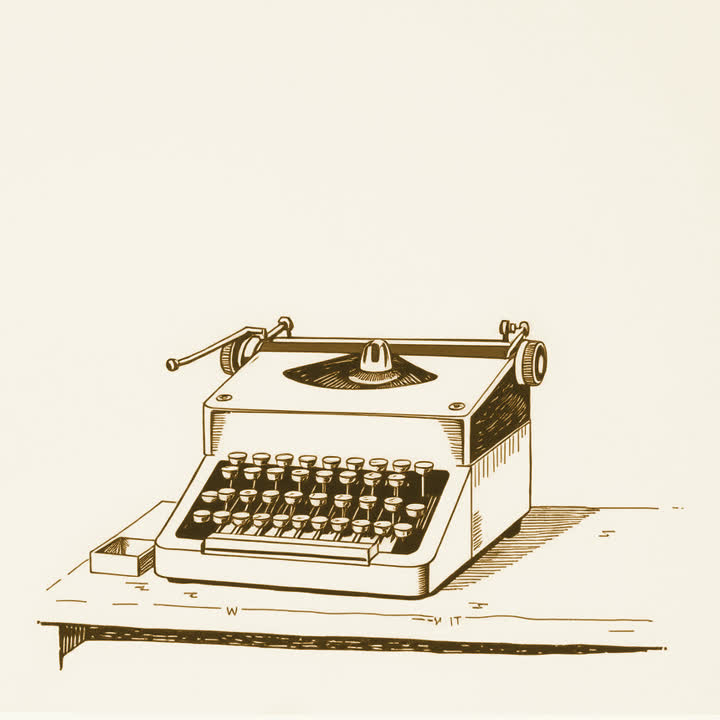
Look down at your keyboard. Somebody made that decision in 1868.
Christopher Latham Sholes was building one of the first typewriters, in Milwaukee. The usual story is that the type bars jammed when neighbouring keys were struck in quick succession. So he spread the common pairs apart. The layout is called QWERTY, after its top row of keys.
Remington bought the design in 1873. Then the typists came.
Typing schools taught the layout because the machines had it. Manufacturers kept the layout because the typists knew it. Within a generation the jamming problem was gone. The keyboard stayed.
That is path dependence.
Where you end up depends on the route you took, not only on where is best. An early choice, often a small one, gets locked in by everything built on top of it. The economist Paul David told the keyboard story this way in 1985. W. Brian Arthur showed the mathematics of it in 1989. Small early advantages compound until the alternative cannot get a foothold.
The famous rival is Dvorak. The famous claim about it is shaky.
August Dvorak patented a rearranged keyboard in 1936 and said it was faster and less tiring. For decades the story ran that a clearly better layout lost to a worse one. Then in 1990 two economists, Stan Liebowitz and Stephen Margolis, went looking for the evidence. They found the trials were thin, and some had been run by Dvorak himself. The layout is probably a little better. It is not the rout the tale needs.
Even so, the lesson holds. Better does not beat installed.
Railway gauges follow the width of the wagons that came before them. A city grows along the roads that were laid when it was a village. A company runs on the software it bought in a hurry twenty years ago. None of these were chosen because they were best. They were chosen, and then everything else was chosen to fit.
What to do with it.
When you are choosing something others will build on, choose slowly. It will outlive the reason you chose it. When you are stuck with something old, ask whether it is still there because it is good, or because it is there. And when someone says the market picked the best option, ask when the market picked. Usually it picked early, and then stopped looking.
Sources
- Clio and the Economics of QWERTY, Paul David, 1985. The paper that made the keyboard the textbook case, in the American Economic Review. Short, readable, and the target of every rebuttal since. Wikipedia’s QWERTY article summarises it and the fight.
- Increasing Returns and Path Dependence in the Economy, W. Brian Arthur, 1994. The mathematics of lock-in, collected. Small early advantages compound until the runner-up cannot catch up, even when it is better.
- The Fable of the Keys, Stan Liebowitz and Stephen Margolis, 1990. The rebuttal, in the Journal of Law and Economics. They dug into the trials behind the Dvorak legend and found them thin. The Wikipedia article on the Dvorak layout covers the dispute fairly.
Nearby ideas
- The sunk cost fallacy. Money already spent is gone, so it should not steer the next choice.
- Chesterton’s fence. Before removing a rule, find out why it was put there.
- The Lindy effect. The longer an idea has lasted, the longer it is likely to last.
- Antifragility. Some things get stronger from knocks, and fail without them.
- The Streisand effect. Trying to hide something is often the best way to spread it.
- The principal-agent problem. When someone acts for you, their own interests quietly steer the work.
- Feedback loops. Why some systems spiral out of control and others settle down.
- The race to the bottom. When rivals keep undercutting each other, everybody loses.