Cobra Effect · Quantum mechanics
How big can an entangled thing be?
Two drums of a trillion atoms each, and the hunt for a size where quantum rules stop.
7 cards, read aloud in 4:23, with a test and sources.
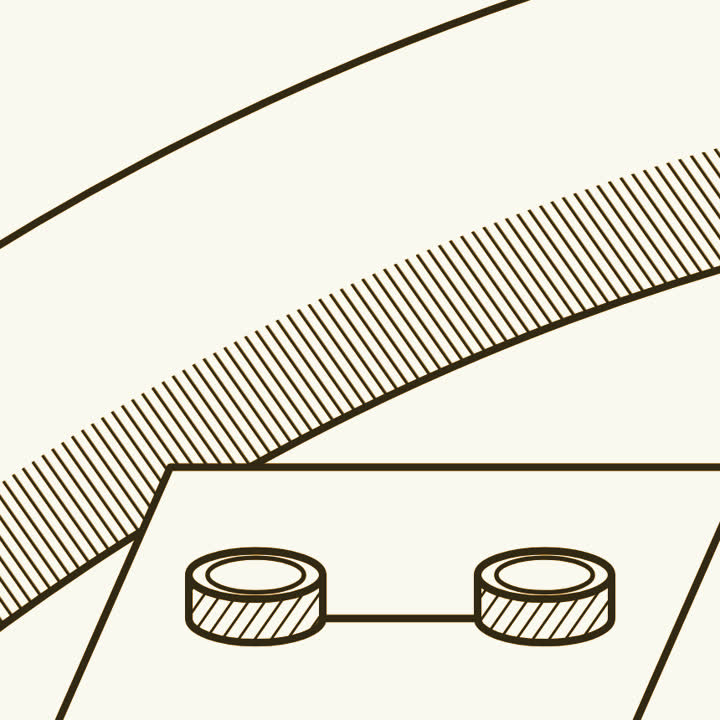
In 2018 a lab in Finland tied two tiny drums together with a quantum link.
Each drum was a skin of aluminium about 15 micrometres across, several times narrower than a human hair. Each held about a trillion atoms. Mika Sillanpää’s team at Aalto University made the two skins tremble in step, matched more closely than any two separate objects can be. That kind of link is called entanglement, and it was first seen between single particles.
Entanglement means two things share a single state.
Erwin Schrodinger gave it the name in 1935, and called it the characteristic trait of quantum mechanics. Measure one of an entangled pair, and the result is random. Compare it with its partner, and the two results line up more closely than chance, or any plan made in advance, could arrange. The first tests, from 1972 on, used pairs of particles of light. Nothing in the theory says it has to stop with particles.
The first large things to be entangled were clouds of gas and a pair of diamonds.
In 2001 Eugene Polzik’s team in Aarhus, Denmark, entangled two glass cells of caesium gas, about a trillion atoms in each, for half a thousandth of a second. In 2011 a team in Oxford led by Ian Walmsley made two diamonds, each about 3 millimetres across, share a single unit of vibration. The diamonds sat 15 centimetres apart, at room temperature. Their link was tested a fraction of a trillionth of a second after it was made. A vibration in diamond dies away in a few trillionths of a second.
The drums were different. They were solid, built by people, and their link lasted.
The two drums sat on one chip, joined by a superconducting circuit carrying microwaves. The chip was cooled to about a hundredth of a degree above absolute zero, because heat is random jiggling, and it would swamp so delicate a state. With the microwaves kept on, the team said, the drums stayed entangled for as long as half an hour. Nothing was in two places. What was linked was the tiny trembling of each skin.
In 2021 a team in Colorado measured the link directly.
At the US National Institute of Standards and Technology, in Boulder, a team built two aluminium drums, each weighing about 70 picograms and holding about a trillion atoms. Earlier work had inferred the entanglement. This team measured the position and momentum of both drums, over ten thousand runs. The two motions matched more closely than the rules allow for two separate objects. The Finnish team published a sister experiment in the same issue of the journal Science.
Nothing in quantum theory sets a size limit. The surroundings do.
Heat, stray air molecules and vibration all carry away traces of a delicate state. Bigger, warmer things shed them faster. That is why these experiments are small, cold and shielded. Some physicists suspect a deeper limit, a size at which quantum behaviour fails by itself. Roger Penrose has proposed that gravity sets one. If such a limit exists, experiments like these are how it will be found. As of 2026, nobody has found a size where entanglement stops.
So when you hear that quantum rules only apply to tiny things, ask where the line is.
Nobody has found one. Two drums of a trillion atoms each have been entangled. In 2023 a team in Zurich ran a strict test of entanglement on two superconducting circuits 30 metres apart, joined by a cooled tube. None of it can carry a message, because each side, taken alone, sees only randomness. The quantum world is not a separate place. It is this one, when things are kept cold, quiet and apart from everything else.
Sources
- NIST Team Directs and Measures Quantum Drum Duet, US National Institute of Standards and Technology, 2021. The clearest plain account of the drum experiment, from the team that measured the entanglement directly.
- Quantum effects enter the macroworld, Stephen Ornes, Proceedings of the National Academy of Sciences, 2019. Why labs keep pushing quantum experiments to bigger objects, what stops them, and what a real size limit would mean.
- Quantum entanglement of two macroscopic objects is the Physics World 2021 Breakthrough of the Year, Physics World. The Colorado and Finnish drum experiments side by side.
- Direct observation of deterministic macroscopic entanglement, Kotler and colleagues, Science, 2021. The Colorado paper, free to read, in which both drums were measured directly over thousands of runs.
Nearby ideas
- Entanglement and Bell’s test. Why two distant particles share results no advance plan can explain.
- Decoherence. Why big things never show two states at once.
- Why does a measurement give one result?. Two rules that clash, four rival answers, and the experiments that could decide.
- Gravity reaches a quantum wave. A tilted crystal, a beam of neutrons, and gravity shifting a quantum wave.
- Superposition and the double slit. One electron at a time, and still a pattern only waves should make.
- The photoelectric effect. The experiment that showed light arrives in packets, not only as waves.
- Atomic spectra and energy levels. Why each element glows in its own few colours, like a fingerprint.
- The uncertainty principle. Why pinning down where a particle is spreads out where it is going.