Cobra Effect · Quantum mechanics
Entanglement and Bell’s test
Why two distant particles share results no advance plan can explain.
7 cards, read aloud in 3:15, with a test and sources.
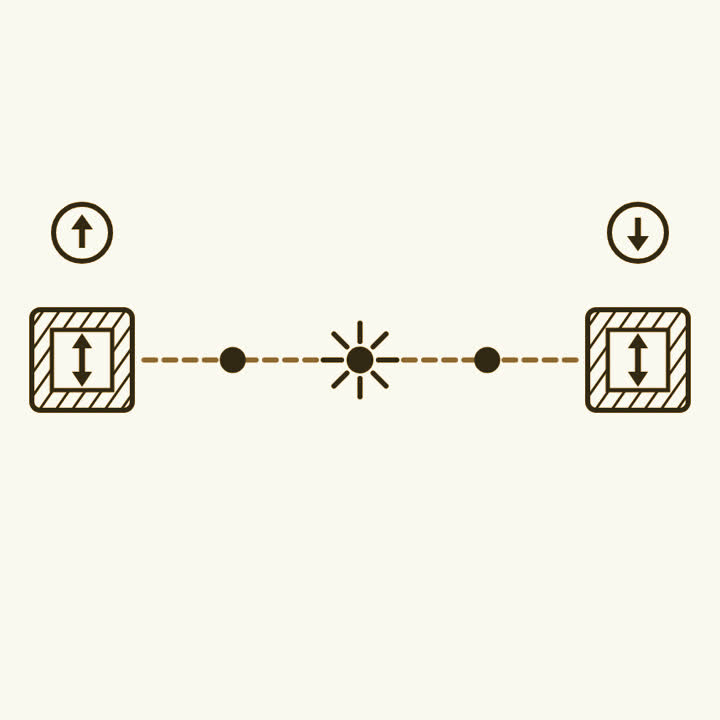
Make two particles together, send them far apart, and measure both.
Measure the spin of each one along the same direction. Whenever one comes out up, the other comes out down. Each result on its own is completely random, like a coin toss. Yet the two always disagree, however far apart they are.
That sounds just like a pair of gloves in two boxes.
Post one glove to Paris and the other to Tokyo. Open the box in Paris, find a left glove, and you know at once that Tokyo has the right. Nothing travelled. The answer was packed in the box from the start. In 1935 Albert Einstein, Boris Podolsky and Nathan Rosen argued that particles must work the same way.
Einstein called the alternative spooky action at a distance.
If the answers were not packed in advance, measuring one particle would seem to settle the other instantly. Einstein could not accept that. He used the phrase in a letter to Max Born in 1947. For almost thirty years, nobody saw a way to tell the two ideas apart.
In 1964 John Bell found a way to test it.
Give each side a box with three buttons and a light that flashes red or green. Press the same button on both boxes, and the lights always differ, like the gloves. Press different buttons, and if the answers were packed inside, the lights could match at most two times in three. Quantum mechanics said the particles would match three times in four. A question about how the world works could now be settled by counting.
The experiments broke Bell’s limit, again and again.
Stuart Freedman and John Clauser did it first, with light, in 1972. In 1982 Alain Aspect’s team switched the settings while the light was already in flight. In 2015 teams in Delft, Vienna and Boulder closed the last big loopholes. Aspect, Clauser and Anton Zeilinger shared the Nobel Prize for it in 2022.
But you cannot use it to send a message.
Each side, looking only at its own results, sees nothing but random ups and downs. The pattern appears only when the two lists are brought together and compared. That comparison has to travel the ordinary way, no faster than light. The link is real, and it carries no news.
So when you hear that two things are instantly connected, ask what could be sent.
Entangled particles really do share results that no advance plan can explain. They are already used to share secret keys, because anyone listening in disturbs the pattern. In 2017 a Chinese satellite sent entangled light to two ground stations more than a thousand kilometres apart. Spooky, yes. A telephone, no.
Sources
- From Einstein and Bell to quantum technologies, Alain Aspect, Nobel lecture, 2022. Aspect on the argument between Einstein and Bohr, Bell’s test, and his own experiments that switched the settings while the light was in flight.
- Entangled states, from theory to technology, The Nobel Prize in Physics 2022, popular information. A plain account of entanglement, Bell’s limit and the experiments by Clauser, Aspect and Zeilinger that broke it.
- Bell’s theorem, Wikipedia. What Bell proved, why answers fixed in advance cannot match quantum results, the loophole free tests of 2015, and why no signal can be sent.
Nearby ideas
- Spin, and the magnet that split a beam. The magnet experiment that showed atoms answer in just two ways.
- The uncertainty principle. Why pinning down where a particle is spreads out where it is going.
- Decoherence. Why big things never show two states at once.
- A photon is a ripple in a field. What a photon actually is: the field itself, raised by one whole step.
- Superposition and the double slit. One electron at a time, and still a pattern only waves should make.
- The photoelectric effect. The experiment that showed light arrives in packets, not only as waves.
- Atomic spectra and energy levels. Why each element glows in its own few colours, like a fingerprint.
- Quantum tunnelling. How particles slip through walls they lack the energy to climb.