Cobra Effect · Quantum mechanics
The photoelectric effect
The experiment that showed light arrives in packets, not only as waves.
7 cards, read aloud in 3:05, with a test and sources.
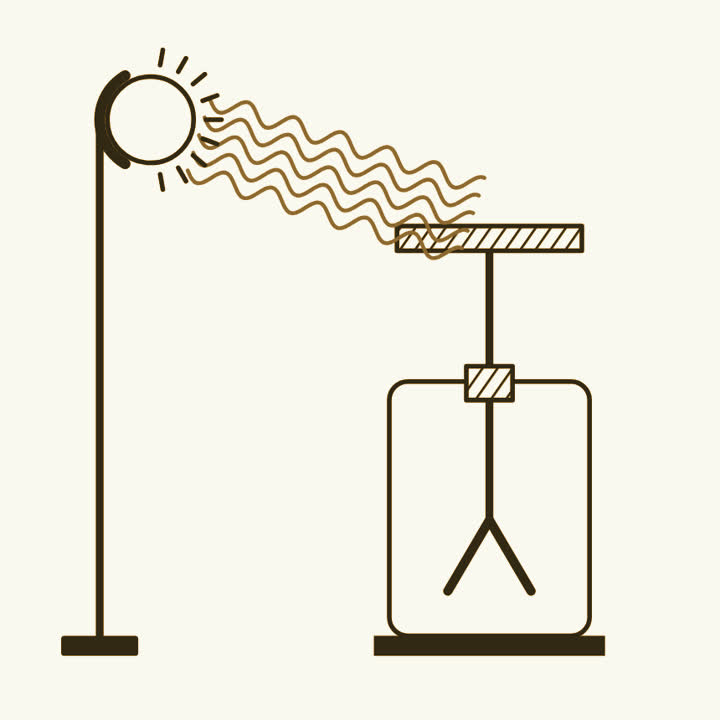
Charge a zinc plate negatively, then shine the brightest lamp you own at it. Nothing happens.
The plate sits on top of an electroscope, a jar with two thin gold leaves hanging inside. While the plate holds its charge, the leaves push each other apart. Red light, white light, a floodlight. Leave it on all afternoon, and the leaves stay apart. Now switch to a small, dim mercury lamp that gives off short wave ultraviolet.
The leaves fall together almost at once.
The faint ultraviolet is knocking electrons out of the zinc, and the charge drains away with them. The bright lamp poured far more light onto the plate, and did nothing. What matters is the colour of the light. Ultraviolet sits just past violet, beyond what eyes can see.
Slide a sheet of window glass into the beam, and the leaves stop falling.
Glass lets visible light through but soaks up ultraviolet. So the ultraviolet was doing it, and nothing else. Wilhelm Hallwachs studied charged plates with an electroscope in 1888, a year after Heinrich Hertz noticed ultraviolet helping sparks to jump. It would take 17 more years to explain.
Waves could not explain it.
A brighter wave carries more energy. Given long enough, it should shake electrons loose, whatever its colour. It never did. In 1902 Philipp Lenard found that brighter light freed more electrons, but not faster ones. Only a bluer light made them leave faster.
In 1905, Albert Einstein said light arrives in packets.
Each packet’s energy is set by its colour. A blue packet carries more than a red one. One packet can free one electron, if it carries enough energy. Under ordinary light, packets don’t team up, so a million weak ones free nothing. Brightness only changes how many arrive.
Robert Millikan set out to prove him wrong, and proved him right.
He spent about ten years on it, scraping the metal clean inside a vacuum so nothing spoiled the surface. By 1916 his measurements fell on the straight line Einstein had predicted. He still doubted the packets. His data didn’t. Einstein’s Nobel Prize named this work, not relativity.
So when you hear that light is a wave, ask what happens when it lands.
Travelling, light spreads and overlaps like a wave. Landing, it arrives whole, one packet at a time. Colour sets the size of each packet. Brightness only sets how many. A dim ultraviolet lamp does what the brightest red floodlight never will.
Sources
- The electron and the light-quant from the experimental point of view, Robert A. Millikan, Nobel lecture, 1924. Millikan’s own account of testing Einstein’s equation, and of how long he went on doubting light in packets after his measurements had confirmed it.
- QED: The Strange Theory of Light and Matter, Richard Feynman, 1985. Feynman says from the first lecture that light is made of particles, and explains how a detector clicks one packet at a time, with no equations.
- Photoelectric effect, Wikipedia. Hertz and Hallwachs’s first observations, Lenard’s measurements, Einstein’s 1905 explanation and Millikan’s test, with the uses in sensors and imaging.
Nearby ideas
- Superposition and the double slit. One electron at a time, and still a pattern only waves should make.
- Atomic spectra and energy levels. Why each element glows in its own few colours, like a fingerprint.
- The uncertainty principle. Why pinning down where a particle is spreads out where it is going.
- Spin, and the magnet that split a beam. The magnet experiment that showed atoms answer in just two ways.
- Quantum tunnelling. How particles slip through walls they lack the energy to climb.
- The exclusion principle. Why no two electrons can share a place, and why that makes matter solid.
- Entanglement and Bell’s test. Why two distant particles share results no advance plan can explain.
- Decoherence. Why big things never show two states at once.