Cobra Effect · Quantum mechanics
Superposition and the double slit
One electron at a time, and still a pattern only waves should make.
7 cards, read aloud in 3:16, with a test and sources.
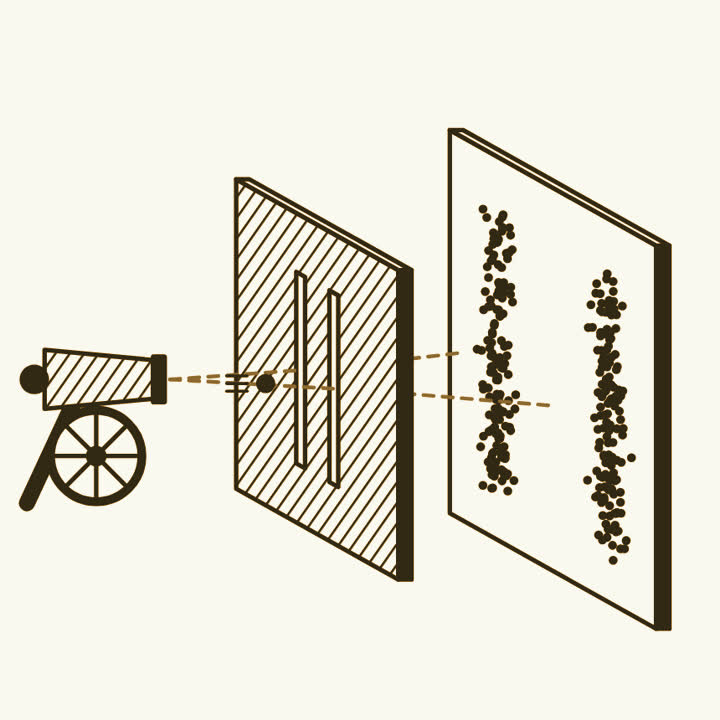
Throw pellets at a board with two slits in it, and you get two stripes.
Behind the board is a screen. Wherever a pellet lands, it leaves a mark. Some pellets go through the left slit, some through the right. Two slits, two stripes of marks. Nothing surprising. Now do the same thing with electrons, and the screen shows something else entirely.
Light did it first, and Thomas Young was savaged in print for saying so.
Around 1803, Young split a narrow beam of sunlight with the edge of a thin card. He did not get two bright patches. He got a row of bright and dark bands. Water does this. Two sets of ripples meet, and where a crest meets a trough, they cancel. So light, Young argued, must be a wave.
Electrons are particles. They arrive one at a time, as single dots.
In 1989, a team at Hitachi sent electrons through the electron version of a double slit, so slowly that one crossed at a time. Each electron hit the screen in one place, like a pellet. At first the dots looked random. Then, over thousands of arrivals, they gathered into bands. Bright, dark, bright.
One electron at a time, and still the pattern that needs two overlapping waves.
Bands need something to pass through both slits and cancel itself. Yet each electron arrives whole, in one spot. Quantum mechanics describes each electron with a wave spread across both slits at once. That spread is called superposition. Where the wave cancels, electrons almost never land.
Put a detector at one slit, and the bands vanish.
Record which slit each electron went through, and you get two plain stripes again, like the pellets. The popular telling says the electron knows it is being watched. It needs no watcher. A detector that records the path is enough, even if nobody ever reads it. Knowing the path and seeing the bands never happen together.
Physicists agree on the maths. They still argue about what it describes.
Richard Feynman said the double slit holds the only real mystery in quantum mechanics. Some say the wave is a real thing. Some say it is only a tool for predicting where the dots will land. In 1999, a team in Vienna got the same bands from molecules made of 60 carbon atoms. Nobody has yet found a size where the bands stop.
So when you hear that a particle is in two places at once, ask one question.
What was actually measured? Nobody has ever seen an electron in two places. We see dots, and bands made of dots. The two places live in the description, and the description predicts the dots exactly. The strangeness is real. It is just more precise than the slogan.
Sources
- Quantum Behavior, Richard Feynman, The Feynman Lectures on Physics, Volume III, 1965. The first chapter of the third volume walks through bullets, water waves and electrons at two slits, and is where Feynman calls it the heart of quantum mechanics.
- QED: The Strange Theory of Light and Matter, Richard Feynman, 1985. Four lectures for a general audience on how light and electrons behave, with no equations and a great deal of honesty about what nobody understands.
- Double-slit experiment, Wikipedia. Young’s original work, the single electron and large molecule versions, and what happens when the path is recorded. Search Tonomura 1989 for the electron build up images.
Nearby ideas
- The photoelectric effect. The experiment that showed light arrives in packets, not only as waves.
- Atomic spectra and energy levels. Why each element glows in its own few colours, like a fingerprint.
- The uncertainty principle. Why pinning down where a particle is spreads out where it is going.
- Spin, and the magnet that split a beam. The magnet experiment that showed atoms answer in just two ways.
- Quantum tunnelling. How particles slip through walls they lack the energy to climb.
- The exclusion principle. Why no two electrons can share a place, and why that makes matter solid.
- Entanglement and Bell’s test. Why two distant particles share results no advance plan can explain.
- Decoherence. Why big things never show two states at once.