Cobra Effect · Incentives and systems
Network effects
Why the biggest network tends to swallow the rest.
6 cards, read aloud in 2:44, with a test and sources.
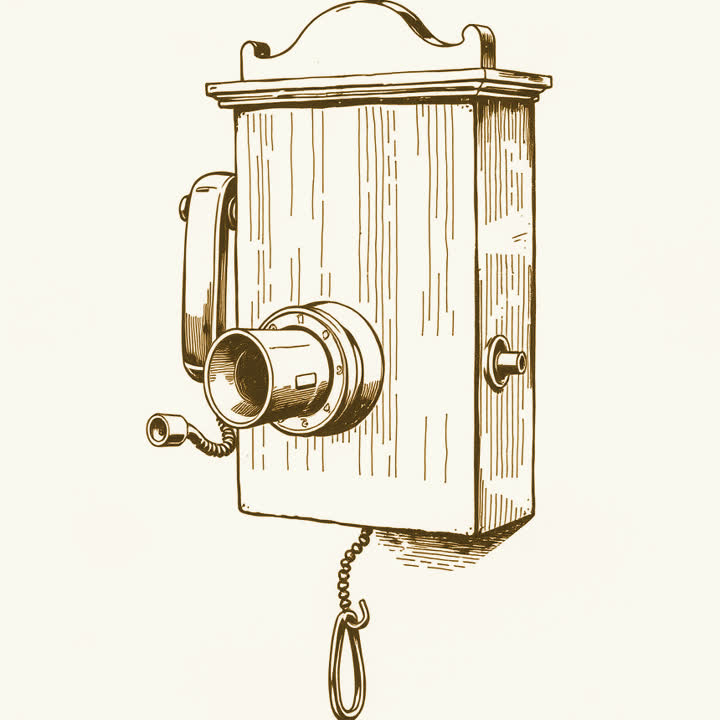
The first telephone in the world was useless. There was nobody to call.
Alexander Graham Bell, 1876. A telephone connects you to everyone else who has a telephone. For the first buyer, that is nobody. The thing only works once other people have it too.
Each new subscriber makes every old telephone worth more.
Theodore Vail, running the Bell company, spelled it out in the 1908 annual report. A telephone without a connection at the other end, he wrote, is not even a toy. Its value depends on the connection with the other telephones, and grows with the number of them. He was writing a business plan. He had also written a law.
That is a network effect.
A product gets more valuable to each user as more people use it. Telephones, fax machines, languages, currencies, social networks. Robert Metcalfe, who co-invented Ethernet, put a number on it around 1980. Double the users and you roughly quadruple the connections, because everyone can now reach everyone. George Gilder named it Metcalfe’s law in 1993. The exact maths is argued over. The direction is not.
Which is why the first users are the hardest to get, and the most valuable.
To the hundredth user, the network is already worth joining. To the first ten, it is worth almost nothing, and they are the only reason the hundredth ever comes. So builders pay for them. Free service, free hardware, a bank paying you to open an account. The seed users are bought at a loss, because they are the price of everyone after.
And why the winner takes most.
Once one network is bigger, it is worth more to join than its rival, so it grows faster still. A tie tips. The loser doesn’t shrink slowly. It empties, because each leaver makes it worth less to those who stay. That is how one telephone company, one video format, one messaging app ends up with nearly everyone.
The questions to ask about anything that connects people.
Does it get better for me when others join? If yes, it is a network, and the early users will have to be paid for. Who is already biggest? They will probably win, unless the thing they run works badly. And if you are building one, don’t sell the product. Sell the other users.
Sources
- Network effect, Wikipedia. The idea, the telephone and fax examples, Vail’s 1908 report, and the arguments about how fast value really grows with users.
- Information Rules, Carl Shapiro and Hal Varian, 1998. The economics of networks, lock-in and standards wars, written for managers just before the web made all of it matter. Still the clearest treatment.
- Metcalfe’s law, Wikipedia. Where the squared rule came from, Gilder naming it in 1993, and the 2005 argument by Odlyzko and Tilly that the true growth is slower.
Nearby ideas
- Path dependence. Why early choices stay locked in long after better ones appear.
- Schelling points. Without talking, people meet at whatever stands out.
- Feedback loops. Why some systems spiral out of control and others settle down.
- The winner’s curse. Win an auction for something uncertain and you probably overpaid.
- Externalities. Why things get overdone when someone else pays part of the cost.
- Schelling’s segregation model. Mild preferences can add up to a sharply divided world.
- The Red Queen effect. When everyone improves at once, running hard only keeps you in place.
- The Cobra effect. Why paying for a result can breed more of the problem.