Cobra Effect · Incentives and systems
The principal-agent problem
When someone acts for you, their own interests quietly steer the work.
6 cards, read aloud in 2:22, with a test and sources.
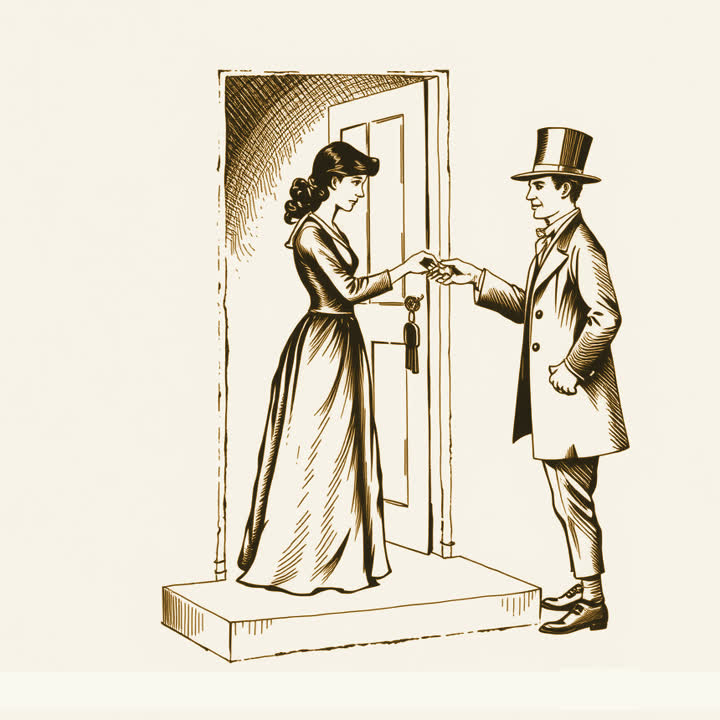
You are selling your house. Your agent has a suggestion.
An offer has come in, a little under what you hoped for. Your agent says the market is soft, this is a good offer, and waiting is a risk. She is the expert. You are nervous. You take it.
Now look at the sums from her side of the desk.
Say the house is $300,000 and her firm takes a 6% commission, split several ways. Holding out another fortnight might get you $10,000 more. Her personal share of that extra money is about $150. Two more weeks of showings costs her far more than that. For her, the smart move is to sell now.
That is the principal-agent problem.
A principal hires an agent to act for them. The agent has interests of their own, and knows things the principal does not. Michael Jensen and William Meckling gave it a theory in 1976. Adam Smith had spotted it two centuries earlier, watching company directors manage other people’s money.
The data on agents’ own houses is the tell.
Steven Levitt and Chad Syverson compared houses that agents sold for clients with houses the agents owned themselves. The agents’ own houses stayed on the market about 9.5 days longer. And sold for about 3.7% more. Same expertise, same market. Different owner.
You are surrounded by agents.
The mechanic who decides what your car needs. The fund manager paid on money gathered, not money made. The executive paid on this year’s share price. The doctor whose fee depends on the treatment. None of them are villains. They are answering the question their pay asks.
Ask what the agent gets paid for.
Not what they say they want. What their money depends on. Then look for where that diverges from what you want. Where it diverges is where you check the work, or change the pay. The advice you get is shaped by the bill you pay.
Sources
- Market Distortions when Agents are Better Informed: The Value of Information in Real Estate Transactions, Steven Levitt and Chad Syverson, 2005. The working paper with the agents’ own houses in it, about 3.7% more and about 9.5 days longer. The abstract on this page says it all.
- Freakonomics, Steven Levitt and Stephen Dubner, 2005. Chapter two tells the estate agent story and works through why the agent’s share of your extra ten thousand dollars is so small.
- Principal–agent problem, Wikipedia. The theory from Jensen and Meckling in 1976, agency costs, and the long list of places it turns up, from executive pay to politics.
Nearby ideas
- Moral hazard. Shield people from a risk and they take more of it.
- The Cobra effect. Why paying for a result can breed more of the problem.
- Goodhart’s law. A measure turned into a target stops telling you the truth.
- Feedback loops. Why some systems spiral out of control and others settle down.
- The race to the bottom. When rivals keep undercutting each other, everybody loses.
- Network effects. Why the biggest network tends to swallow the rest.
- The winner’s curse. Win an auction for something uncertain and you probably overpaid.
- Externalities. Why things get overdone when someone else pays part of the cost.