Cobra Effect · Incentives and systems
The race to the bottom
When rivals keep undercutting each other, everybody loses.
6 cards, read aloud in 2:46, with a test and sources.
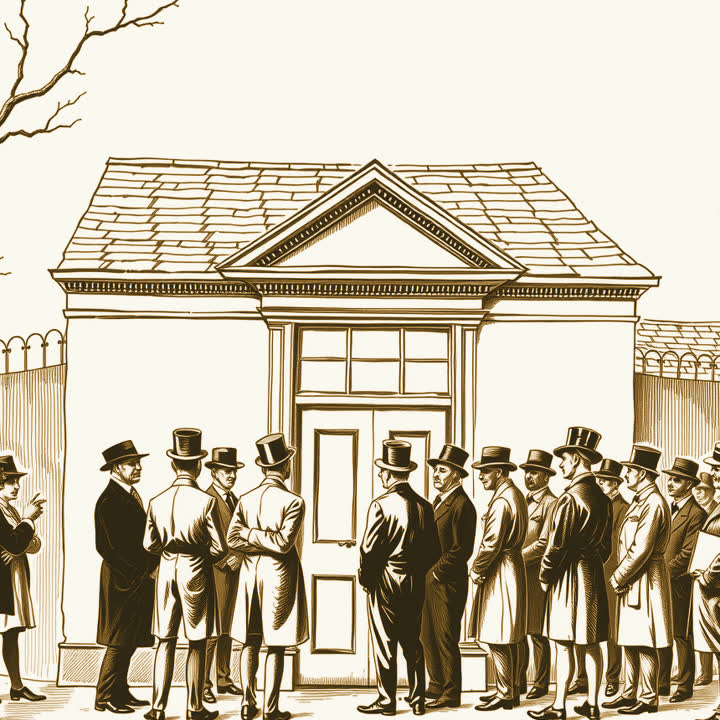
New Jersey, the 1890s. A small state discovers it can sell its law.
Every company must be chartered somewhere, and the state that charters it collects the fees. New Jersey rewrites its rules to let companies do almost anything they like. The big firms flock in. Delaware watches, and takes notes.
Delaware wins by asking for less.
In 1913 New Jersey tightened its rules again. Delaware kept its loose ones, and the companies moved. Today more than half of America’s listed companies are chartered in a state where most of them do little or no business. Not because its law is best. Because its law asks least.
Justice Brandeis called it a race of laxity.
1933. Louis Brandeis, dissenting in a Supreme Court case about chain stores, looked back at the charter wars. The states had competed, he wrote, in a race not of diligence but of laxity. The phrase race to the bottom came later. The picture was his. Each state was right to cut. All of them together were worse off.
That is a race to the bottom.
Several players compete by lowering a standard. Taxes, wages, safety rules, the fees a port charges. Each cut wins business from the others, so the others cut too. When the race ends, everyone has the share they started with, and the standard is gone. The competition destroyed the thing it was competing over.
It isn’t always a race down. Sometimes competition raises the bar.
Economists have argued about this since Charles Tiebout in 1956. If families can move between towns, towns compete to offer better schools and parks. That is a race to the top. The direction depends on who is choosing. When the customer is a company picking where to be taxed, the bar drops. When it is a family picking where to live, the bar can rise.
The fix is a floor everyone agrees to stand on.
A race to the bottom only stops when the racers stop competing on that one thing. A minimum wage, a treaty on tax, a league rule about spending. The floor is unpopular with whoever was winning. So before you cut a standard to win business, ask what happens when the other side cuts back. If the answer is that you both end up lower and level, you weren’t winning. You were digging.
Sources
- Race to the bottom, Wikipedia. The idea, the Delaware charter story, and the Brandeis dissent. Search Liggett v. Lee 1933 for the dissent itself. The race of laxity line is near the end of it.
- Louis D. Brandeis: A Life, Melvin Urofsky, 2009. The judge who wrote the dissent, and why he spent decades worrying about what big companies did to small states. Long, but the chapters on the court years stand alone.
- Tiebout model, Wikipedia. The other side of the argument. Charles Tiebout in 1956 on why towns competing for residents can be a race to the top, and the conditions it needs.
Nearby ideas
- The tragedy of the commons. Why shared things get used up, and how communities stop it.
- The prisoner’s dilemma. Why two sensible people can both choose the worst outcome.
- The Cobra effect. Why paying for a result can breed more of the problem.
- Network effects. Why the biggest network tends to swallow the rest.
- The winner’s curse. Win an auction for something uncertain and you probably overpaid.
- Externalities. Why things get overdone when someone else pays part of the cost.
- Schelling’s segregation model. Mild preferences can add up to a sharply divided world.
- The Red Queen effect. When everyone improves at once, running hard only keeps you in place.