Cobra Effect · Quantum mechanics
Spin, and the magnet that split a beam
The magnet experiment that showed atoms answer in just two ways.
7 cards, read aloud in 3:12, with a test and sources.
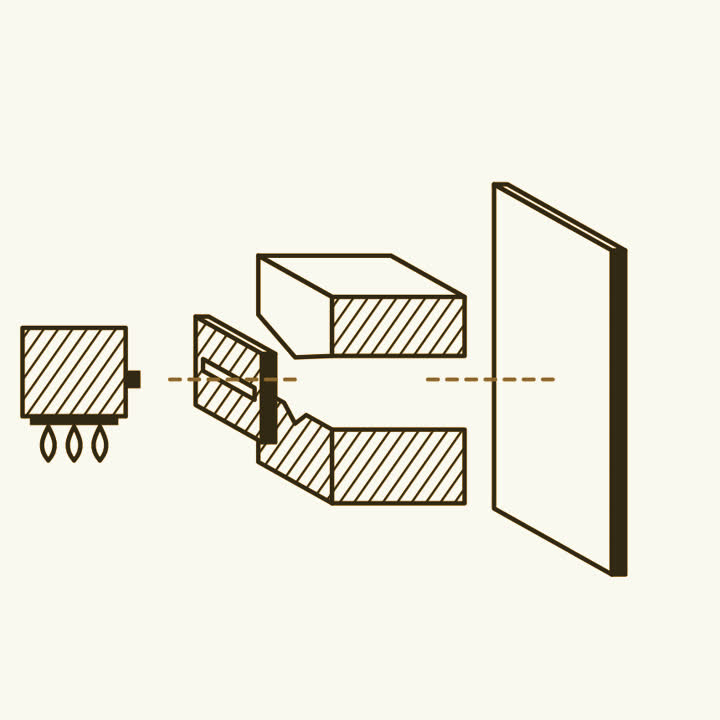
Frankfurt, 1922. Two physicists fire silver atoms through a magnet.
Otto Stern and Walther Gerlach heat silver in a small oven until atoms stream out in a thin beam. The beam passes between the poles of a magnet shaped to be stronger on one side than the other. Each silver atom behaves like a tiny magnet, so the field should push it up or down. Beyond the magnet, a glass plate catches where the atoms land.
Tiny magnets tilted every which way ought to leave a smear.
An atom tilted one way would be pushed hard, another hardly at all, most somewhere in between. So the plate should show one long smear, from top to bottom. That is what a handful of compass needles, thrown in at every angle, would do. It is not what happened.
The plate showed two separate marks, and nothing in between.
Every atom went one way or the other. Up, or down, never partway. The deposit was so faint, as Stern later told it, that it only showed once sulphur from a cheap cigar turned the silver black. Gerlach sent Niels Bohr a postcard of the result. An atom’s magnetism, it seemed, could only point two ways.
It took three more years to find out why.
Stern and Gerlach thought they had confirmed an older idea about how atoms line up. In 1925 George Uhlenbeck and Samuel Goudsmit proposed the real reason. The electron itself carries a little built in magnetism, which came to be called spin. Measured along any direction you choose, it only ever gives one of two answers.
Now send the up atoms through a second magnet turned on its side.
Keep only the atoms that went up, and block the rest. Turn the next magnet at right angles to the first. Half go left, and half go right. Being up told the atom nothing about left or right.
Then ask about up and down again, and the old answer is gone.
Take only the atoms that went left, and send them through an upright magnet once more. Every one of them went up before. Now half go up and half go down. Asking about left and right wiped out what was known about up and down. Physics teachers have taught spin with chains of magnets like this since Feynman’s lectures, and experiments bear it out.
So when you hear that a particle has a spin, ask along which direction.
Spin is not a tiny ball turning on its axis. It is a property that answers only the question you put to it, one direction at a time. It is also at work in hospitals. MRI scanners build their pictures by flipping the spins of hydrogen nuclei in your body. Two answers, along any direction, and no answer at all to the question you did not ask.
Sources
- The method of molecular rays, Otto Stern, Nobel lecture, 1946. Stern’s own account of shooting beams of atoms through magnets, and what the split of the silver beam showed about atoms.
- Spin One, Richard Feynman, The Feynman Lectures on Physics, Volume III, 1965. The fifth chapter builds quantum mechanics out of chains of Stern Gerlach magnets, filtering and refiltering beams exactly as the story does.
- Stern–Gerlach experiment, Wikipedia. The 1922 experiment, the cigar story and the postcard to Bohr, and chains of magnets. For the cigar, search Friedrich and Herschbach, Physics Today, 2003.
Nearby ideas
- The uncertainty principle. Why pinning down where a particle is spreads out where it is going.
- Superposition and the double slit. One electron at a time, and still a pattern only waves should make.
- Quantum tunnelling. How particles slip through walls they lack the energy to climb.
- The exclusion principle. Why no two electrons can share a place, and why that makes matter solid.
- Entanglement and Bell’s test. Why two distant particles share results no advance plan can explain.
- Decoherence. Why big things never show two states at once.
- A photon is a ripple in a field. What a photon actually is: the field itself, raised by one whole step.
- The photoelectric effect. The experiment that showed light arrives in packets, not only as waves.