Cobra Effect · Quantum mechanics
Quantum tunnelling
How particles slip through walls they lack the energy to climb.
7 cards, read aloud in 3:17, with a test and sources.
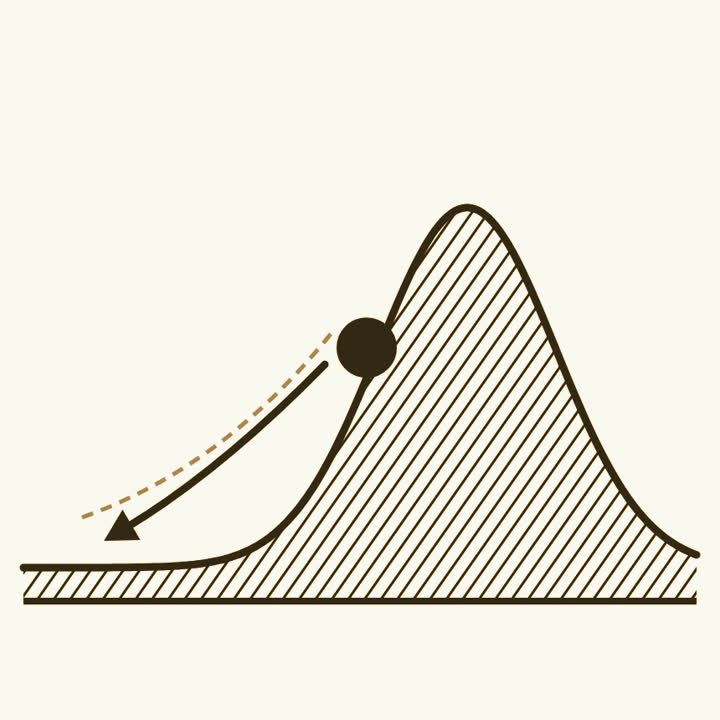
Roll a ball at a hill too steep for it, and it rolls back. Every time.
Without enough speed, it climbs part of the way up. Then it stops, and rolls back down the side it came from. It never turns up on the far side. Fire an electron at a barrier it lacks the energy to cross, and it does something a ball never does.
Some of the time, it turns up on the other side.
Its wave does not stop dead at the barrier. It fades away inside it, and if the barrier is thin enough, a little of the wave is still there on the far side. Wherever the wave reaches, the electron can be found. Physicists call this tunnelling.
Make the barrier thicker, and the chance does not just shrink. It collapses.
A little extra thickness cuts the chance of getting through many times over. That is why tunnelling matters for electrons and atomic nuclei, and never for footballs. For something the size of a person, the chance of passing through a wall is too small to happen once in the life of the universe.
In 1928 tunnelling explained why some atoms fall apart.
An alpha particle is trapped inside a nucleus, behind a wall of energy it cannot climb. George Gamow, and separately Ronald Gurney and Edward Condon, showed that it can tunnel out. Small differences in the wall make enormous differences in the wait. Uranium 238 takes four and a half billion years to lose half its atoms. Polonium 212 takes less than a millionth of a second.
The Sun only shines because of it.
In the Sun’s core, hydrogen nuclei have to get close enough to fuse. Their electric charges push them apart, and by the old rules the core is nowhere near hot enough to force them together. Tunnelling lets a small share of them slip through that push anyway. That small share is enough to power the Sun.
In 1981 two physicists used it to see single atoms.
Gerd Binnig and Heinrich Rohrer, at IBM in Zurich, held a sharp metal tip just above a surface. Electrons tunnel across the gap, and the current changes about tenfold when the gap changes by less than the width of an atom. Sweep the tip across while holding the current steady, and it traces the atoms one by one. They shared a Nobel Prize for it in 1986.
So when something is said to be impossible to get through, ask how thick the wall is.
For big things, walls are walls. The odds are far too small to matter. For electrons, a thin enough barrier leaks. Flash memory, the kind in your phone, stores data by using a strong voltage to push electrons through a very thin insulating layer. The rule is not that anything goes. The chance depends, exactly, on how thick the wall is.
Sources
- Scanning tunneling microscopy, from birth to adolescence, Gerd Binnig and Heinrich Rohrer, Nobel lecture, 1986. The two inventors on how a tip held a few atoms above a surface, and the steepness of tunnelling, let them see single atoms.
- Quantum tunnelling, Wikipedia. How a wave leaks through a barrier, why the chance falls so steeply with thickness, and its part in radioactive decay, the Sun and electronics.
- Scanning tunneling microscope, Wikipedia. How the microscope holds its tip over a surface, how sensitive the current is to the gap, and the atoms it has moved and pictured.
Nearby ideas
- The uncertainty principle. Why pinning down where a particle is spreads out where it is going.
- Atomic spectra and energy levels. Why each element glows in its own few colours, like a fingerprint.
- The exclusion principle. Why no two electrons can share a place, and why that makes matter solid.
- Entanglement and Bell’s test. Why two distant particles share results no advance plan can explain.
- Decoherence. Why big things never show two states at once.
- A photon is a ripple in a field. What a photon actually is: the field itself, raised by one whole step.
- Superposition and the double slit. One electron at a time, and still a pattern only waves should make.
- The photoelectric effect. The experiment that showed light arrives in packets, not only as waves.