Cobra Effect · Quantum mechanics
The exclusion principle
Why no two electrons can share a place, and why that makes matter solid.
7 cards, read aloud in 3:13, with a test and sources.
Press your hand down on a table. Why doesn’t it sink in?
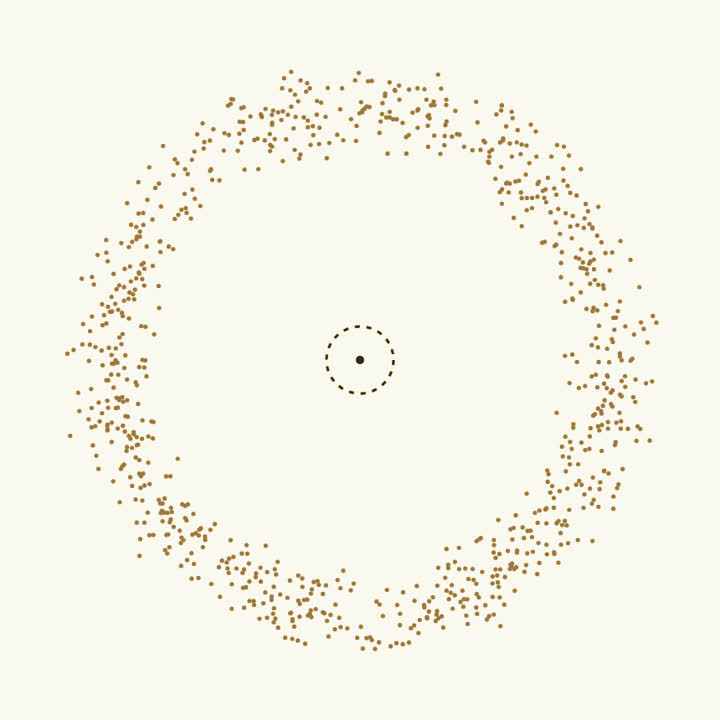
Atoms are almost entirely empty space. If the nucleus of an atom were the size of a pea, the whole atom would be the size of a large stadium. So what stops the atoms of your hand drifting into the atoms of the table? Much of the answer is a rule a young physicist wrote down in 1925.
Wolfgang Pauli said no two electrons can be in exactly the same state.
Each electron in an atom has a level, a shape, a direction and a spin. Pauli’s rule is that no two electrons in one atom can match on all four. So two can share a place only by having opposite spins, one up and one down. He wrote the rule to fit the facts. The deeper reason took another fifteen years.
So electrons have to stack up, and that builds the periodic table.
The first shell of an atom holds two electrons. The next holds eight. Helium has two, which fill the first shell exactly, and it barely reacts with anything. Lithium has one more, which has to start the next shell, and it reacts eagerly. Every new row of the periodic table begins a new outer shell.
Squeeze electrons together, and the rule pushes back.
Forced into a smaller space, electrons cannot all crowd into the lowest states. They are pushed into higher and higher ones, and that takes energy. The result is a pressure that has nothing to do with heat. In 1967 Freeman Dyson and Andrew Lenard showed that without the rule, ordinary matter would collapse.
It even holds up dead stars.
A white dwarf is what is left when a star like the Sun runs out of fuel. It packs roughly the mass of the Sun into something about the size of the Earth. Gravity pulls it tighter, but its electrons refuse to share states, and they push back. In 1930 Subrahmanyan Chandrasekhar worked out the most they can hold, a little under one and a half times the mass of the Sun.
Light does not follow the rule, and lasers depend on that.
Particles of light are happy to crowd into exactly the same state. A laser fills one state with an enormous number of them, all in step. Electrons, protons and neutrons keep to one each. Light does the opposite. Which kind a particle is decides whether it takes up room.
So when something feels solid, ask what is really holding it up.
Not stuff packed tightly together. Atoms are mostly empty. Much of the firmness of matter comes from electrons that cannot share a state. The same rule stacks up the periodic table and props up dead stars. Your hand stops at the table largely because its electrons are not allowed to crowd in.
Sources
- Exclusion principle and quantum mechanics, Wolfgang Pauli, Nobel lecture, 1946. Pauli on how he arrived at the rule that no two electrons share a state, and how it fitted the pattern of the periodic table.
- On stars, their evolution and their stability, Subrahmanyan Chandrasekhar, Nobel lecture, 1983. Chandrasekhar on the limit to how much a white dwarf can hold before its electrons give way to gravity.
- Pauli exclusion principle, Wikipedia. The rule, the particles it applies to and the ones it does not, and its part in atoms, the stability of matter and white dwarf stars.
Nearby ideas
- Spin, and the magnet that split a beam. The magnet experiment that showed atoms answer in just two ways.
- Atomic spectra and energy levels. Why each element glows in its own few colours, like a fingerprint.
- Entanglement and Bell’s test. Why two distant particles share results no advance plan can explain.
- Decoherence. Why big things never show two states at once.
- A photon is a ripple in a field. What a photon actually is: the field itself, raised by one whole step.
- Superposition and the double slit. One electron at a time, and still a pattern only waves should make.
- The photoelectric effect. The experiment that showed light arrives in packets, not only as waves.
- The uncertainty principle. Why pinning down where a particle is spreads out where it is going.