Cobra Effect · Quantum mechanics
A photon is a ripple in a field
What a photon actually is: the field itself, raised by one whole step.
7 cards, read aloud in 4:23, with a test and sources.
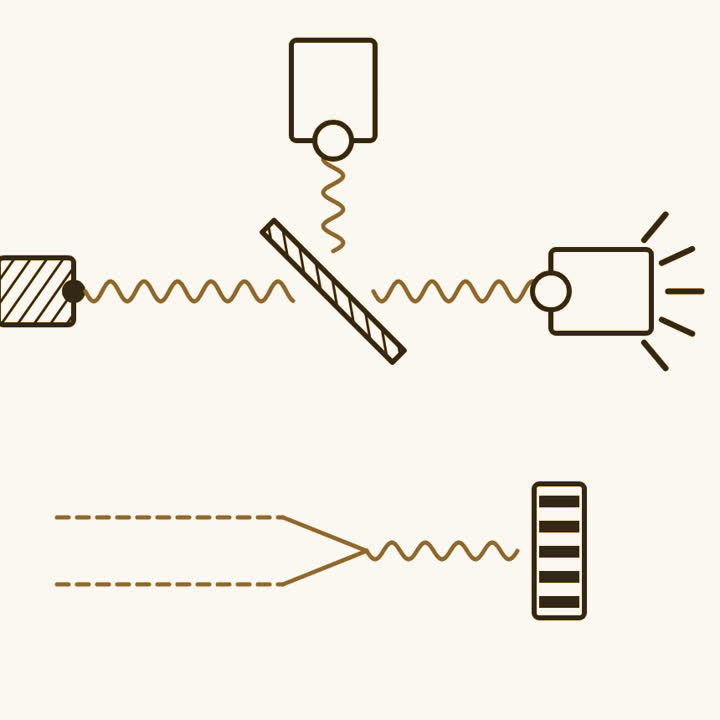
Paris, 1986. Light meets a half silvered mirror, one packet at a time.
Philippe Grangier, Gerard Roger and Alain Aspect put a detector on each side of the mirror. A packet went one way or the other. The two detectors never clicked together. Then they let the two paths meet again, and the packets built up bright and dark bands. One packet, both paths. So what is it that travels?
The old answer was a tiny ball of light. It never quite fitted.
A ball goes one way at the mirror. Bands need something that took both. Albert Einstein proposed the packets in 1905. Gilbert Lewis named them photons in a letter to Nature in 1926. Physicists lived with two pictures. A wave while travelling, a particle on landing. Two pictures for one thing is a sign that neither is the thing.
In 1927 Paul Dirac gave a different answer. There is no ball. There is a field.
James Clerk Maxwell had shown that light is a wave in the electromagnetic field, which fills all of space. Dirac applied the quantum rules to the field itself, treating each of its vibrations like a plucked string that can only hold whole steps of energy. Each vibration can gain or lose energy only in whole lumps. One lump is a photon. A photon is not a thing inside the field. It is the field, raised by one step.
Put an atom between two mirrors set close enough, and it forgets how to shine.
An excited atom normally drops its energy into the field around it, and a photon leaves. In 1981 Daniel Kleppner at MIT saw that between two mirrors closer than the light’s wavelength, the field has no vibration of that size to take the energy. In 1985 his group sent excited atoms between such mirrors. The atoms held their energy far longer, unable to emit. A photon needs somewhere in the field to exist. Take that away, and it is never made.
Even with no photons in it at all, the field is never quite still.
In 1947 Willis Lamb and Robert Retherford found two energy levels of hydrogen sitting slightly apart, where the theory of the day said they should be equal. Hans Bethe explained it that same year. The field’s restless jitter nudges the electron, even in a vacuum. In 1948 Hendrik Casimir predicted that two uncharged plates in a vacuum would pull together, and in 1997 Steven Lamoreaux measured that pull to within five percent. How much of that pull needs the jitter is still argued. The shift in hydrogen needs it. A field with no photons in it is not nothing. It is a field at rest, and its rest is never perfect.
Every particle turns out to be like this.
The electron is a ripple in an electron field. Quarks are ripples in quark fields. The fields fill all of space, and particles are their whole steps. This is quantum field theory. Dirac began it, and Richard Feynman, Julian Schwinger and Shinichiro Tomonaga finished the part about light and electrons in the late 1940s. That part, quantum electrodynamics, predicts a magnetic property of the electron to about one part in a billion, and the measurement agrees. It is often called the most precisely tested theory in physics.
So when someone asks whether light is a wave or a particle, ask what is waving.
The field is waving. Its energy is counted in whole lumps. Travelling, a lump is spread through the field, both paths at once. Landing, it is handed over whole, to one detector. Wave and particle are two words for one thing, seen at two moments. Next time a lamp comes on, picture it stirring a field that reaches your eye, one step at a time.
Sources
- The Quantum Theory of the Emission and Absorption of Radiation, Paul Dirac, Proceedings of the Royal Society A, 1927. The paper that treated the electromagnetic field as a set of quantum oscillators and made photons its steps. Search the title; the Wikipedia article on the photon tells its history.
- QED: The Strange Theory of Light and Matter, Richard Feynman, 1985. Four lectures for a general audience on how light and electrons really behave, with no equations and no ball of light anywhere.
- Quantum field theory, Wikipedia. The history from Dirac’s 1927 paper to the Standard Model, and why every particle is treated as a ripple in a field.
Nearby ideas
- The photoelectric effect. The experiment that showed light arrives in packets, not only as waves.
- Light is a wave of electricity and magnetism. How equations predicted invisible waves, and sparks across a room proved them real.
- Superposition and the double slit. One electron at a time, and still a pattern only waves should make.
- Atomic spectra and energy levels. Why each element glows in its own few colours, like a fingerprint.
- The uncertainty principle. Why pinning down where a particle is spreads out where it is going.
- Spin, and the magnet that split a beam. The magnet experiment that showed atoms answer in just two ways.
- Quantum tunnelling. How particles slip through walls they lack the energy to climb.
- The exclusion principle. Why no two electrons can share a place, and why that makes matter solid.